Ultrasound Services in Newport Beach — 2D, 3D & 4D Ultrasound | Broad Medical Group (949) 720-9848
Ultrasound Services · Newport Beach · 2026

2D, 3D & 4D Ultrasound
In-Office Imaging

See your baby clearly. Diagnose with confidence.

Ultrasound is the primary imaging tool in obstetrics and gynecology — safe, radiation-free, and available in real time. At Broad Medical Group, Dr. Broad performs diagnostic and elective ultrasound in the office, reviewing results with you during your visit. This guide explains what each type of ultrasound shows, when scans are performed during pregnancy, and what to expect at your appointment.

◆ Short Answer

The Canonical Answer

Obstetric and gynecologic ultrasound uses sound waves to create real-time images of internal structures — no radiation is involved, and it is considered safe throughout pregnancy ACOG PB #175. 2D ultrasound is the standard diagnostic modality for pregnancy dating, anatomy surveys, growth monitoring, and gynecologic evaluation. 3D ultrasound adds surface rendering that is particularly useful for evaluating facial and skeletal abnormalities ISUOG 2020. 4D ultrasound provides real-time 3D video of fetal movement. Most low-risk pregnancies include at least a dating scan (6–8 weeks) and an anatomy scan (18–22 weeks); high-risk pregnancies may require serial monitoring AIUM 2023. At Broad Medical Group, Dr. Jennifer Broad performs and interprets all ultrasounds in-office for patients in Newport Beach and Orange County.

Dr. Jennifer Broad headshot
Medically reviewed by Dr. Jennifer Broad, MD, FACOG Board-Certified Obstetrician-Gynecologist · Newport Beach, CA
Last reviewed: April 2026 Next review: October 2026
Ultrasound suite at Broad Medical Group â€

Ultrasound Services at Broad Medical Group

Broad Medical Group provides in-office diagnostic and elective ultrasound services for both obstetric and gynecologic patients. Having ultrasound available in the office means results are immediate — Dr. Broad performs and interprets scans during your visit, answering questions in real time rather than requiring a separate imaging appointment and delayed results.

Ultrasound is used throughout pregnancy for:

  • Pregnancy dating and viability — confirming gestational age, heartbeat, and location
  • Anatomy surveys — detailed structural assessment of fetal development
  • Fetal growth monitoring — tracking growth in high-risk pregnancies
  • Cervical length assessment — screening for preterm birth risk
  • Amniotic fluid and placental evaluation — ensuring adequate fluid and normal placental position

Ultrasound is also essential for gynecologic evaluation — assessing fibroids, ovarian cysts, endometrial abnormalities, and pelvic pain. It is completely safe, uses no radiation, and can be performed as often as clinically needed.

Types of Ultrasound

Type What It Shows Primary Uses
2D Ultrasound Standard cross-sectional, real-time grayscale imaging. The foundation of all diagnostic ultrasound. Dating, anatomy survey, growth, amniotic fluid, placental location, fetal position, cervical length, gynecologic evaluation
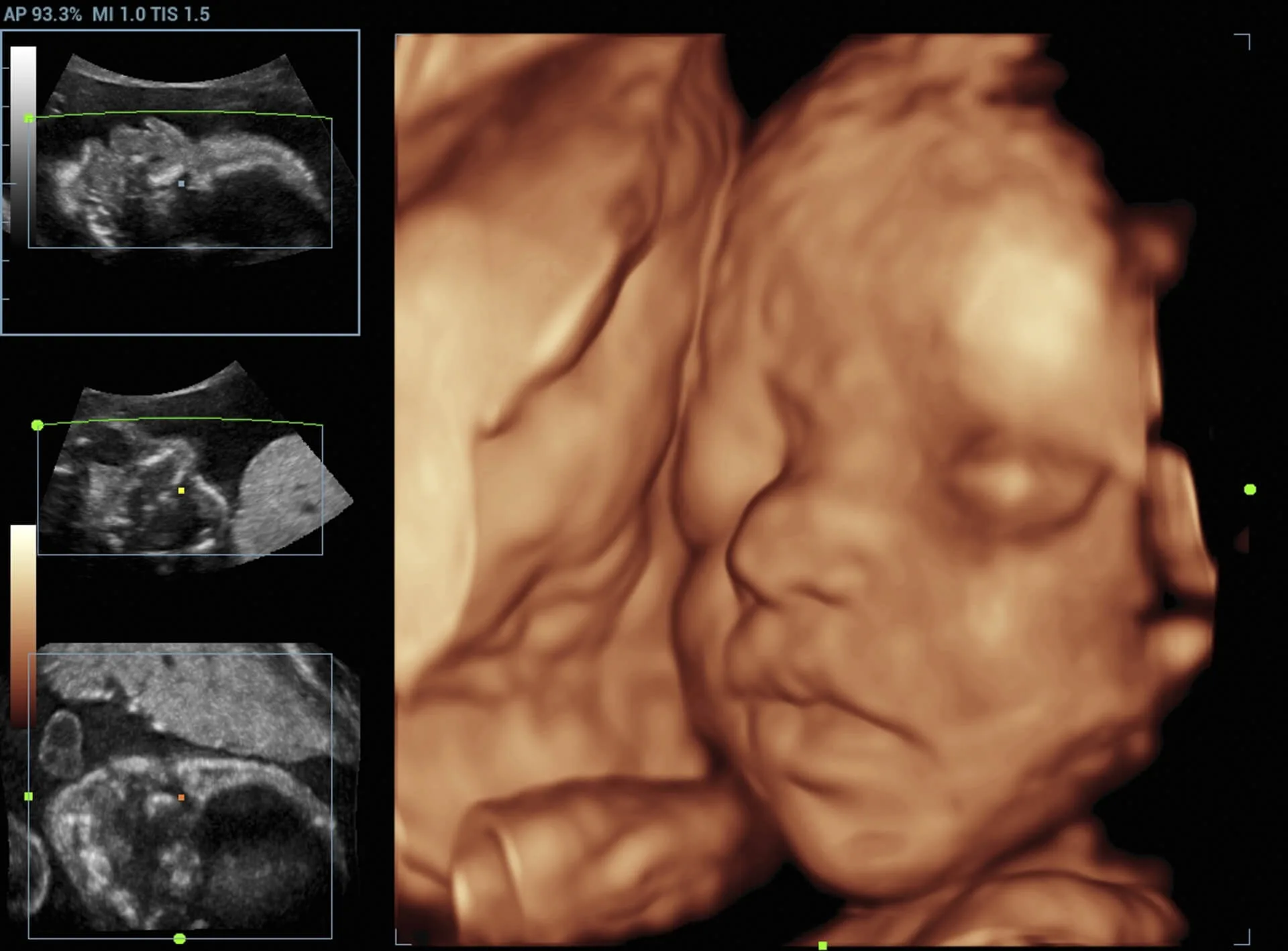
3D Ultrasound Surface rendering that creates a three-dimensional image. Shows facial features, body contours, and surface anatomy in detail. Evaluating cleft lip/palate, neural tube defects, skeletal abnormalities, uterine anomalies, elective imaging for parents
4D Ultrasound Real-time 3D video — live motion of the baby in three dimensions. See yawning, sucking thumb, stretching, and facial expressions. Elective bonding sessions, assessment of fetal movement patterns, enhanced evaluation of surface abnormalities
Transvaginal Higher-resolution imaging using an internal probe placed in the vaginal canal. Provides closer, more detailed views. Early pregnancy (first trimester viability), ectopic pregnancy evaluation, gynecologic assessment (fibroids, ovarian cysts, endometrial thickness), cervical length
Transabdominal External probe on the abdomen with gel. Standard approach for most second and third trimester imaging. Anatomy scan, growth scans, fetal position, amniotic fluid assessment, 3D/4D imaging

2D ultrasound remains the clinical standard for all diagnostic purposes. It provides the measurements, anatomic detail, and functional assessment that guide clinical decisions. 3D and 4D capabilities are complementary — they provide additional information in specific clinical scenarios (particularly surface abnormalities) and offer parents a remarkable visual experience, but they do not replace the diagnostic 2D examination.

When Ultrasounds Are Performed During Pregnancy

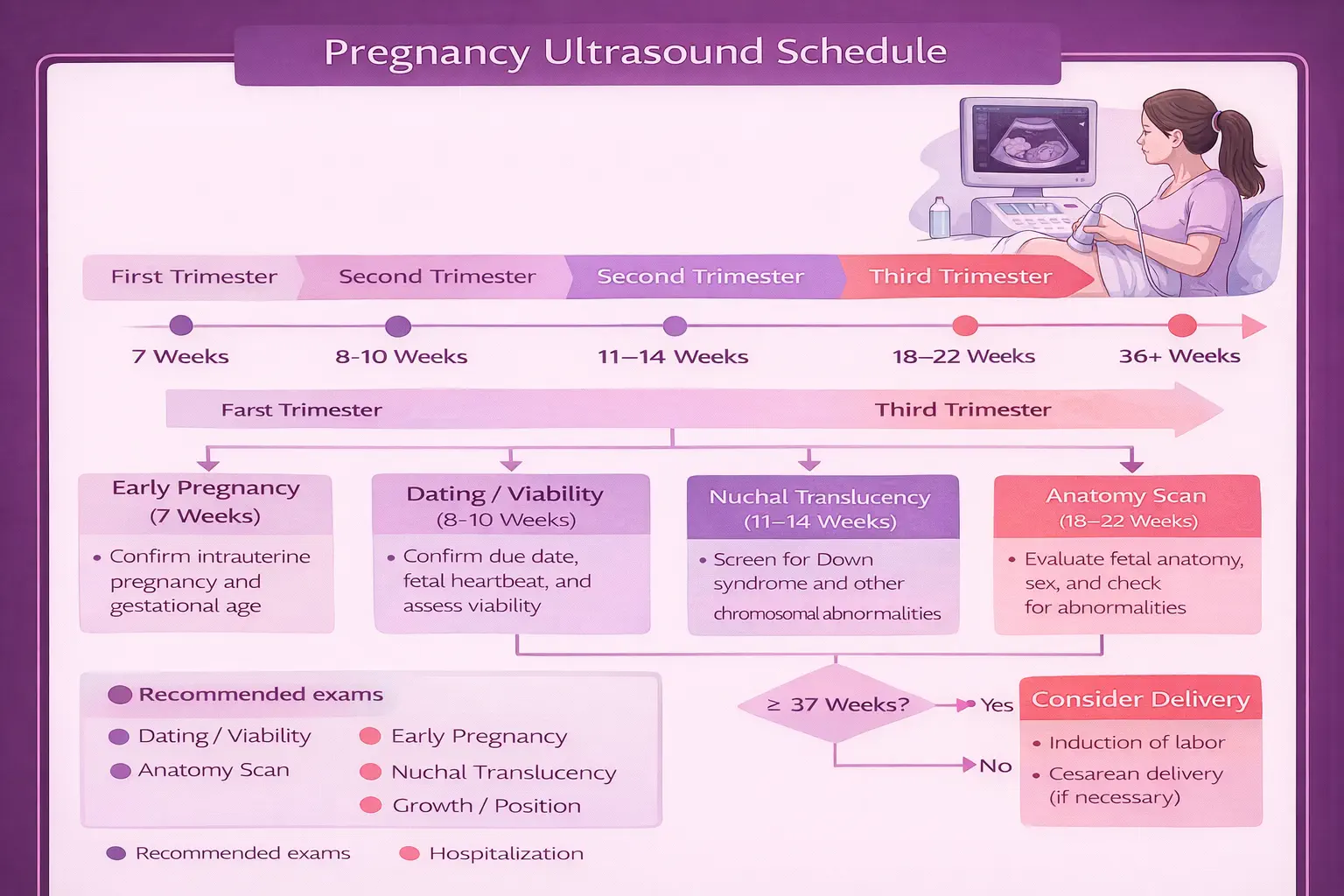
Dating Ultrasound (6–8 Weeks)

The first ultrasound of pregnancy is typically performed between 6 and 8 weeks. This scan confirms that the pregnancy is located in the uterus (ruling out ectopic pregnancy), establishes viability by detecting a fetal heartbeat, determines the number of embryos, and provides accurate gestational dating. First-trimester dating by ultrasound is the most accurate method for establishing a due date — accurate to within 5 to 7 days. This is usually a transvaginal ultrasound, as the embryo is too small to visualize well through the abdomen at this stage.

First Trimester Screening (11–14 Weeks)

If combined first trimester screening is elected, a specialized ultrasound measures the nuchal translucency (NT) — a fluid collection at the back of the baby’s neck. Increased NT thickness, combined with maternal blood markers (PAPP-A and free beta-hCG), provides risk assessment for Down syndrome and other chromosomal abnormalities. This scan must be performed within a narrow window (11 weeks 0 days to 13 weeks 6 days).

Anatomy Scan (18–22 Weeks)

The anatomy scan — also called the mid-trimester survey or “20-week ultrasound” — is the most comprehensive ultrasound of pregnancy. It is a systematic evaluation of fetal anatomy including the brain, face, spine, heart (four-chamber view and outflow tracts), kidneys, bladder, stomach, limbs, and umbilical cord. Placental location, amniotic fluid volume, and cervical length are also assessed. This is typically when fetal sex can be determined if desired. The anatomy scan takes 30 to 45 minutes.

Growth Ultrasounds (As Needed)

Serial growth ultrasounds are performed when there is concern about fetal growth — either too small (intrauterine growth restriction) or too large (macrosomia). These are typically ordered every 2 to 4 weeks and include measurements of the head, abdomen, and femur to calculate estimated fetal weight. Growth monitoring is standard in high-risk pregnancies including preeclampsia, gestational diabetes, multiple gestations, and chronic hypertension.

Third Trimester (As Needed)

Third trimester ultrasounds may be performed to assess fetal position (particularly if breech presentation is suspected near term), amniotic fluid volume, placental location (confirming a low-lying placenta has migrated), and fetal well-being. Not every patient requires a third trimester ultrasound, but they are common in the later weeks of pregnancy.

For a complete breakdown of the prenatal screening schedule, see our Prenatal Care Guide.

Ultrasound timeline during pregnancy - visual showing dating scan, NT screening, anatomy scan, growth scans, and third trimester evaluation mapped across 40 weeks
Ultrasound schedule during pregnancy. Timing varies by clinical indication and risk factors.

Gynecologic Ultrasound

Ultrasound is not exclusively a pregnancy tool. Gynecologic ultrasound is a fundamental part of evaluating a wide range of conditions outside of pregnancy. At Broad Medical Group, pelvic ultrasound is performed in-office for:

  • Fibroids — determining the size, number, and location of uterine fibroids. Location (submucosal, intramural, subserosal) affects symptoms and treatment options.
  • Ovarian cysts — characterizing cysts as simple (fluid-filled, usually benign) or complex (may require further evaluation or monitoring). Most simple cysts resolve spontaneously.
  • Endometrial thickness — essential in the workup of abnormal uterine bleeding, particularly in postmenopausal patients. A thickened endometrial stripe may warrant further evaluation with endometrial biopsy.
  • Pelvic pain evaluation — identifying potential causes including ovarian pathology, endometriomas, adenomyosis, and free fluid.
  • IUD placement confirmation — verifying proper positioning of intrauterine devices after insertion.
  • Fertility assessment — antral follicle count (AFC) by ultrasound is part of ovarian reserve testing. Uterine evaluation for fibroids, polyps, or structural anomalies that may affect fertility. See our Fertility & Preconception Care guide.

Gynecologic ultrasound is typically performed transvaginally, which provides higher-resolution images of the uterus and ovaries compared to the transabdominal approach. The exam is brief (usually 10 to 15 minutes) and results are reviewed with you immediately.

3D/4D Elective Sessions

In addition to diagnostic imaging, Broad Medical Group offers elective 3D and 4D ultrasound sessions for parents who want to see their baby in greater detail. These sessions provide stunning surface-rendered images and real-time video — see your baby yawning, stretching, sucking their thumb, and making facial expressions.

Best Timing: 26–32 Weeks

The optimal window for elective 3D/4D imaging is between 26 and 32 weeks of pregnancy. At this stage:

  • The baby has developed enough subcutaneous fat for detailed facial features
  • There is still enough amniotic fluid and room for the baby to move into favorable positions
  • Facial expressions and movements are well-developed

Earlier scans (20–25 weeks) can still produce good images but facial features appear less filled-out. Later scans (33+ weeks) may be limited by the baby’s larger size and tighter quarters.

What Affects Image Quality

Several factors influence the clarity of 3D and 4D images:

  • Baby’s position — a face-up or profile position is ideal. If the baby is face-down or facing the spine, facial images may be limited.
  • Placental location — an anterior placenta (on the front wall of the uterus) can create a barrier between the transducer and the baby.
  • Amniotic fluid volume — adequate fluid around the face acts as an acoustic window. Low fluid can limit image quality.
  • Maternal body habitus — more tissue between the transducer and the baby can affect resolution.

If conditions are not ideal on the day of your appointment, Dr. Broad will still obtain the best images possible and may recommend rescheduling if visualization is significantly limited.

Patient Tip

Schedule your 3D/4D session between 26 and 32 weeks for the best images. The sweet spot is around 28 weeks. Drink plenty of water in the days leading up to your appointment — good hydration supports amniotic fluid levels. 3D/4D sessions can be added to a scheduled prenatal visit or booked as a standalone appointment.

Important Note

3D/4D ultrasound is not a substitute for diagnostic imaging. Elective 3D/4D sessions are a wonderful bonding experience, but they do not replace the standard 2D anatomy scan. The anatomy scan at 18–22 weeks provides the systematic structural evaluation needed to assess fetal development. 3D/4D is a complement, not a replacement.

What to Expect

Before Your Scan

For some transabdominal ultrasounds — particularly early pregnancy scans — you may be asked to arrive with a full bladder. A full bladder pushes the uterus into a better position for imaging and creates an acoustic window that improves image quality. You will be instructed on preparation when scheduling. For transvaginal scans and most second/third trimester scans, no special preparation is needed.

During the Scan

You will lie on an exam table. For transabdominal ultrasound, warm gel is applied to your abdomen and a handheld transducer is moved across the surface. For transvaginal ultrasound, a slim, lubricated probe is gently inserted into the vaginal canal. Neither approach is painful, though transvaginal ultrasound may cause mild pressure.

Scan duration varies by type:

  • Dating/viability scan: 15–20 minutes
  • Anatomy scan: 30–45 minutes
  • Growth scan: 20–30 minutes
  • Gynecologic scan: 10–15 minutes
  • 3D/4D elective session: 20–30 minutes

Results

At Broad Medical Group, Dr. Broad reviews results with you in real time during your appointment. You will see the images on the screen as they are captured, and Dr. Broad will explain what is being evaluated and what the findings show. There is no waiting for results to come back from an outside facility — this is a significant advantage of in-office imaging.

Safety

Diagnostic ultrasound uses sound waves — not radiation. It has been used in obstetrics for over 50 years with no confirmed adverse effects on mother or baby. Both ACOG and the American Institute of Ultrasound in Medicine (AIUM) endorse the safety of diagnostic ultrasound when performed by qualified providers for clinical indications. The ALARA principle (As Low As Reasonably Achievable) guides all imaging — using the minimum exposure needed for diagnostic purposes.

Key Takeaways
  • 2D ultrasound is the diagnostic standard — used for dating, anatomy surveys, growth monitoring, and gynecologic evaluation.
  • 3D ultrasound adds surface rendering — helpful for evaluating cleft lip, neural tube defects, and skeletal abnormalities, and provides detailed images for parents.
  • 4D ultrasound is real-time 3D video — see your baby moving, yawning, and making facial expressions in live motion.
  • Most pregnancies include at least two scans — a dating ultrasound (6–8 weeks) and the anatomy scan (18–22 weeks). High-risk pregnancies may require more.
  • Best timing for 3D/4D is 26–32 weeks — enough fat for facial detail, enough room for movement.
  • Ultrasound is completely safe — no radiation, over 50 years of use with no confirmed adverse effects.
  • Results are reviewed in real time — Dr. Broad performs and interprets all scans in-office during your visit.

References & Clinical Sources

  1. American College of Obstetricians and Gynecologists. Practice Bulletin No. 175: Ultrasound in Pregnancy. Obstetrics & Gynecology, 128(6), e241–e256. 2016. Reaffirmed 2024.
  2. American Institute of Ultrasound in Medicine. AIUM Practice Parameter for the Performance of Detailed Second- and Third-Trimester Diagnostic Obstetric Ultrasound Examinations. 2023.
  3. International Society of Ultrasound in Obstetrics and Gynecology. ISUOG Practice Guidelines: Performance of Third-Trimester Obstetric Ultrasound. Ultrasound in Obstetrics & Gynecology, 56(4), 619–636. 2020.

Related Resources

Your Baby. In Focus.

Whether you need a diagnostic scan or want to see your baby in 3D, Broad Medical Group provides in-office ultrasound with same-visit results. Dr. Broad is accepting new patients in Newport Beach and Orange County.

Book an Ultrasound →

Broad Medical Group — Newport Beach, California

Medical Disclaimer: This content is for educational purposes only and does not constitute medical advice, diagnosis, or treatment. Consult Dr. Jennifer Broad or your healthcare provider for guidance specific to your situation. Current as of April 2026. If you are experiencing a medical emergency, call 911 immediately.