When bleeding is too heavy, too long, or too unpredictable.
Abnormal uterine bleeding is one of the most common reasons women see their gynecologist — and one of the most undertreated. Whether your periods have become heavier, longer, more irregular, or you are experiencing bleeding after menopause, there is always a reason. This guide covers how abnormal bleeding is classified, evaluated, and treated — from medical management to surgical options.
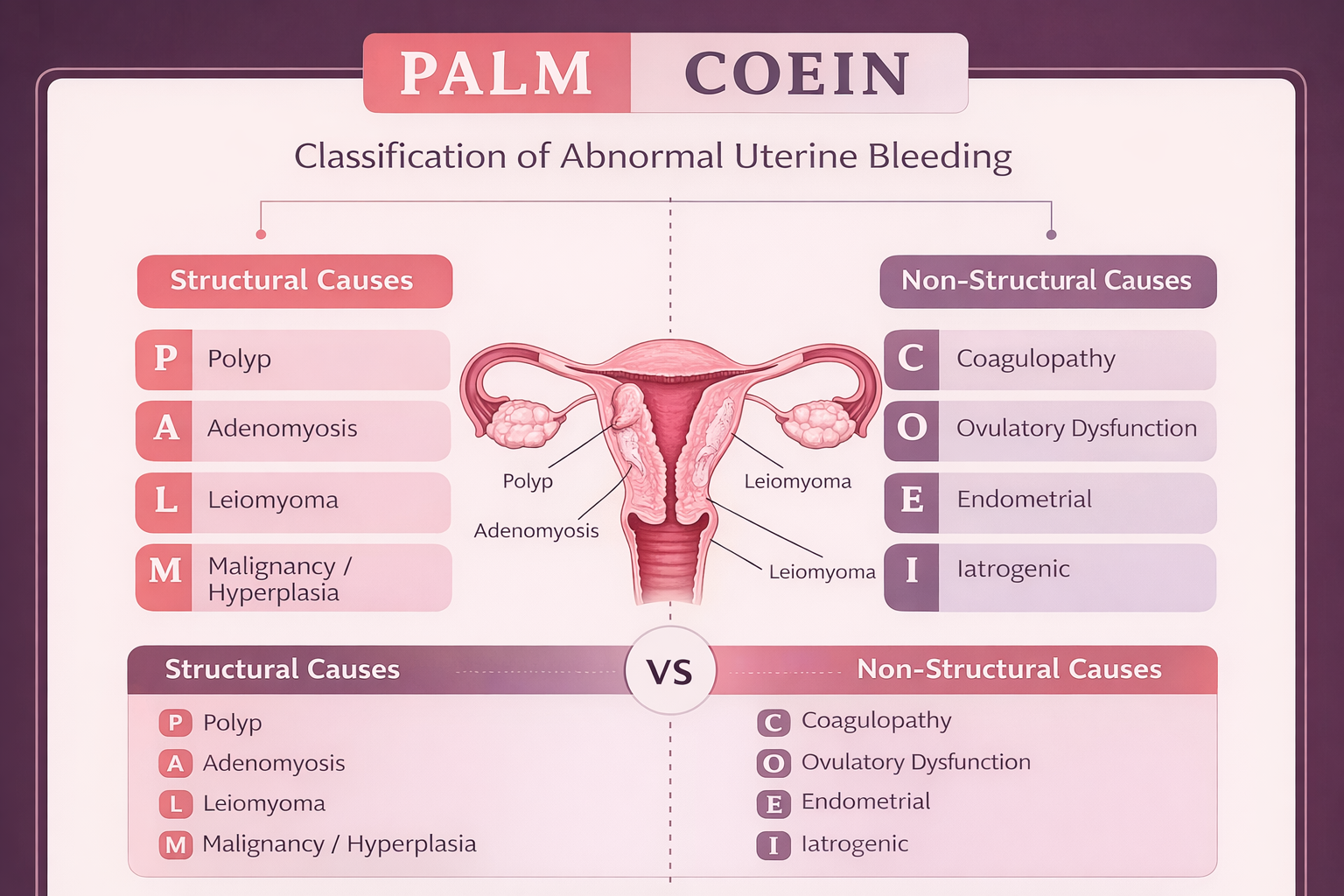
Abnormal uterine bleeding (AUB) includes menstrual bleeding that is too heavy (menorrhagia — soaking through protection hourly), too long (>7 days), too frequent (<21-day cycles), between periods, or after menopause ACOG PB #128. The FIGO PALM-COEIN classification organizes causes into structural (Polyp, Adenomyosis, Leiomyoma, Malignancy) and non-structural (Coagulopathy, Ovulatory dysfunction, Endometrial, Iatrogenic, Not yet classified) FIGO 2011. Evaluation includes history, labs, transvaginal ultrasound, and endometrial biopsy when indicated. Treatment options include the Mirena IUD (reduces bleeding up to 90%) Cochrane 2020, hormonal and non-hormonal medications, and surgical procedures including endometrial ablation, hysteroscopic surgery, and hysterectomy ACOG CO #557. At Broad Medical Group, Dr. Jennifer Broad provides evidence-based evaluation and individualized treatment for abnormal uterine bleeding in Newport Beach.
Abnormal uterine bleeding (AUB) is any bleeding from the uterus that differs from your normal menstrual pattern. A “normal” menstrual cycle occurs every 24–38 days, lasts 4–8 days, and involves blood loss that does not interfere with daily activities. When bleeding falls outside these parameters, evaluation is warranted.
Abnormal uterine bleeding can present in several ways:
AUB is one of the most common reasons women visit their gynecologist, accounting for approximately one-third of outpatient gynecology visits. Despite how common it is, many women tolerate heavy or irregular bleeding for years before seeking help — often assuming it’s normal or that nothing can be done. In virtually every case, there is an identifiable cause and an effective treatment.
FIGO (the International Federation of Gynecology and Obstetrics) developed the PALM-COEIN classification system to standardize the way we describe and categorize the causes of abnormal uterine bleeding. The system divides causes into two categories: structural (things that can be seen on imaging or pathology) and non-structural (functional or systemic causes).
| Category | Cause | How It’s Identified |
|---|---|---|
| PALM — Structural Causes | ||
| P | Polyp | Endometrial or cervical polyps — seen on ultrasound, saline infusion sonography (SIS), or hysteroscopy |
| A | Adenomyosis | Endometrial tissue within the uterine muscle wall — identified on ultrasound or MRI; causes heavy, painful periods |
| L | Leiomyoma (Fibroids) | Benign uterine tumors — most common structural cause; submucosal fibroids have greatest impact on bleeding. See Uterine Fibroids Guide |
| M | Malignancy & Hyperplasia | Endometrial cancer or precancerous changes — identified by endometrial biopsy; risk increases with age, obesity, chronic anovulation |
| COEIN — Non-Structural Causes | ||
| C | Coagulopathy | Bleeding disorders (e.g., von Willebrand disease) — affects up to 13% of women with heavy periods; identified by coagulation studies |
| O | Ovulatory Dysfunction | Irregular or absent ovulation (PCOS, thyroid disease, perimenopause) — leads to unpredictable, often heavy bleeding; identified by history and labs |
| E | Endometrial | Primary disorder of the endometrium itself — often a diagnosis of exclusion when other causes are ruled out |
| I | Iatrogenic | Caused by medications or devices — anticoagulants, hormonal contraceptives, copper IUD |
| N | Not Yet Classified | Rare causes that don’t fit the above categories — arteriovenous malformations, cesarean scar defects |
Understanding the cause of abnormal bleeding is the foundation of effective treatment. A woman with heavy bleeding from a submucosal fibroid needs a different approach than a woman with heavy bleeding from a coagulopathy or ovulatory dysfunction. The PALM-COEIN system ensures that the evaluation is systematic and that no common cause is overlooked.
Many women have more than one contributing cause. For example, a woman may have both a small submucosal fibroid (L) and ovulatory dysfunction from perimenopause (O). Dr. Broad uses this classification framework to ensure that all contributing factors are identified and addressed in your treatment plan.
Any bleeding after menopause requires prompt evaluation. While many causes of postmenopausal bleeding are benign (vaginal atrophy, polyps), approximately 10% of women with postmenopausal bleeding are found to have endometrial cancer. Even light spotting should be evaluated. Do not assume it is “just hormones” — schedule an appointment.
Contact your OBGYN if you are experiencing any of the following:
Many women normalize heavy or irregular bleeding because it has been their pattern for years, or because they assume other women experience the same thing. Heavy bleeding that disrupts your life is not normal — and it is not something you should have to build your schedule around.
ACOG recommends a structured evaluation of heavy menstrual bleeding that includes history, physical exam, laboratory testing (CBC for anemia, thyroid function, and coagulation studies when indicated), transvaginal ultrasound, and endometrial biopsy for women over 45 or those with risk factors for endometrial hyperplasia.
A thorough menstrual history is the first and most important step. Dr. Broad will ask about the duration, frequency, and heaviness of your periods, when the pattern changed, associated symptoms (pain, clotting, fatigue), medications, contraceptive use, and family history of bleeding disorders. A menstrual tracking app or diary is extremely helpful — the more specific the data, the more efficient the evaluation.
A physical examination evaluates the size and shape of the uterus (enlarged with fibroids or adenomyosis), checks for cervical lesions or polyps, and assesses for signs of other pelvic pathology.
Transvaginal ultrasound is the first-line imaging study. It evaluates the uterus for fibroids, adenomyosis, endometrial thickness, and ovarian pathology. When greater detail about the endometrial cavity is needed (to evaluate for polyps or submucosal fibroids), saline infusion sonography (SIS) uses sterile saline to distend the cavity during ultrasound, providing a clearer view.
An in-office procedure that samples the uterine lining for pathologic evaluation. Indicated for women over age 45 with abnormal bleeding, or younger women with risk factors for endometrial hyperplasia (obesity, chronic anovulation, PCOS, diabetes, tamoxifen use). The biopsy rules out endometrial cancer and hyperplasia.
A thin camera is inserted through the cervix to directly visualize the endometrial cavity. Hysteroscopy is both diagnostic (identifying polyps, fibroids, or other lesions) and therapeutic (removing them in the same procedure). For information on this and other minimally invasive procedures, see our dedicated guide.
For many women, medical management is the first step — and for many, it is the only step needed. The choice of treatment depends on the underlying cause, the severity of bleeding, whether you are trying to conceive, and your preferences.
The levonorgestrel-releasing intrauterine device is one of the most effective medical treatments for heavy menstrual bleeding. It releases a small amount of progestin directly into the uterus, thinning the endometrial lining. The result: a reduction in menstrual blood loss of up to 90%. Many women have very light periods or stop menstruating altogether. The Mirena IUD is effective for up to 8 years and also provides highly effective contraception.
The Mirena IUD is not just a contraceptive — it is a treatment for heavy periods. ACOG and NICE both recommend the hormonal IUD as a first-line medical treatment for heavy menstrual bleeding. If you have been told you need a hysterectomy for heavy periods, the Mirena IUD may be worth trying first. Learn more in our IUD & Birth Control guide.
Birth control pills regulate the menstrual cycle, reduce menstrual blood loss, and can eliminate irregular bleeding. They are a good option for women who also need contraception or who have irregular cycles from ovulatory dysfunction. OCPs are not appropriate for women over 35 who smoke or those with certain cardiovascular risk factors.
Oral progestins (medroxyprogesterone acetate, norethindrone) can be used cyclically to regulate bleeding or continuously to suppress it. The injectable progestin (Depo-Provera) reduces or eliminates periods in most women after several months. Progestins are particularly useful for women with ovulatory dysfunction or those who cannot take estrogen.
GnRH agonists (leuprolide) temporarily suppress ovarian function and induce a medical menopause, stopping menstrual bleeding entirely. These are typically used short-term (3–6 months) to control severe bleeding before surgery, to allow recovery from anemia, or to shrink fibroids preoperatively. They are not a long-term solution because of bone density loss and menopausal side effects.
Tranexamic acid is an antifibrinolytic medication that reduces bleeding by preventing the breakdown of blood clots in the endometrium. It is taken only during the days of heavy bleeding (typically 3–5 days per cycle) and reduces menstrual blood loss by approximately 40–50%. It is a good option for women who prefer to avoid hormones or who are trying to conceive.
Non-steroidal anti-inflammatory drugs (ibuprofen, naproxen) taken during menstruation reduce prostaglandin production, which decreases both bleeding and cramping. They reduce menstrual blood loss by approximately 20–40% and are most effective when started 1–2 days before the expected period.
Many women with chronic heavy bleeding develop iron-deficiency anemia — sometimes severe enough to cause debilitating fatigue, dizziness, shortness of breath, and difficulty concentrating. Iron replacement is an essential part of the treatment plan. Oral iron (ferrous sulfate, taken with vitamin C to enhance absorption) is first-line; intravenous iron infusion may be necessary for severe deficiency or when oral iron is not tolerated.
Surgery is considered when medical management has not provided adequate relief, when a structural cause requires removal, or when the patient prefers a definitive solution. The choice of procedure depends on the cause of bleeding, severity, whether you want to preserve fertility, and your goals.
Endometrial ablation destroys the uterine lining to reduce or eliminate menstrual bleeding. It is a minimally invasive procedure performed in the operating room, typically in under 10 minutes. Approximately 70–80% of women have significantly lighter periods or no periods after ablation.
Ablation is an excellent option for women who have completed childbearing and want to avoid hysterectomy. It is not appropriate for women who want to preserve fertility, as pregnancy after ablation carries serious risks. A reliable form of contraception is required after the procedure.
When polyps or submucosal fibroids are identified as the cause of abnormal bleeding, hysteroscopic removal is often both diagnostic and curative. A camera and specialized instruments are inserted through the cervix — no abdominal incisions. Recovery is typically 1–2 days. This approach preserves the uterus and fertility.
For larger fibroids or those within the uterine wall (intramural) or on the surface (subserosal), a laparoscopic or robotic myomectomy removes the fibroids while preserving the uterus. This is the preferred approach for women who want to maintain fertility. For more detail, see our Uterine Fibroids guide and Minimally Invasive Surgery overview.
Hysterectomy — removal of the uterus — is the definitive treatment for abnormal uterine bleeding. It eliminates menstrual bleeding entirely and permanently. Hysterectomy is considered when:
Most hysterectomies for AUB are performed minimally invasively — laparoscopic or robotic — with shorter recovery, less pain, and faster return to normal activities compared to open surgery.
The decision between medical management, ablation, myomectomy, and hysterectomy is highly individual. Key factors include:
Dr. Broad walks through each option — including expected outcomes, risks, recovery, and what to expect — so you can make a fully informed decision that aligns with your goals.

If your bleeding is affecting your daily life, your energy, or your peace of mind, Dr. Broad provides expert evaluation and the full range of treatment options — from medical management to minimally invasive surgery — in Newport Beach.
Schedule an Evaluation →