What to expect at every visit. What gets tested and when. What to bring and what to ask.
Prenatal care is the foundation of a healthy pregnancy. From your first visit through delivery, a structured schedule of check-ups, screenings, and conversations ensures that both you and your baby are monitored at every stage. This guide covers the ACOG-recommended visit schedule, what happens at each appointment, trimester-specific milestones, and how Dr. Broad’s practice handles the transition if routine care needs to become high-risk care.
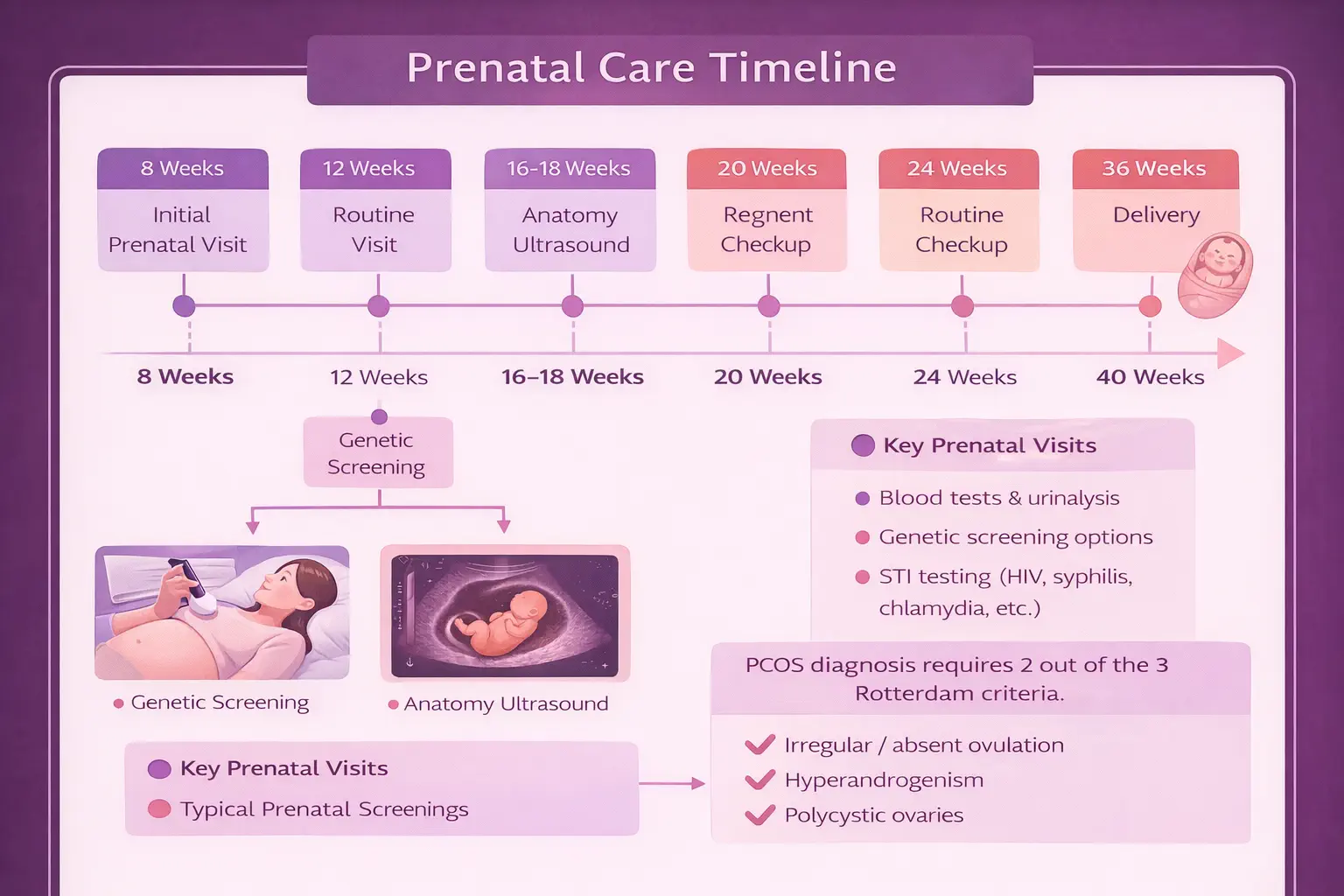
Prenatal care follows a structured schedule recommended by the American College of Obstetricians and Gynecologists (ACOG): visits every 4 weeks through 28 weeks, every 2 weeks from 28 to 36 weeks, and weekly from 36 weeks until delivery ACOG Guidelines. The first prenatal visit — ideally at 6 to 8 weeks — includes a comprehensive health history, dating ultrasound, initial lab work, risk assessment, and discussion of genetic screening options. Each trimester brings specific milestones: first trimester genetic screening and NIPT (available from 10 weeks), second trimester anatomy ultrasound (18–22 weeks) and glucose screening (24–28 weeks), and third trimester Group B Strep testing (36–37 weeks) and birth planning ACOG CO #878; CDC Immunization Schedule. Not all pregnancies remain routine — elevated blood pressure, abnormal glucose screening, or growth concerns may warrant enhanced monitoring under high-risk pregnancy care. At Broad Medical Group, Dr. Jennifer Broad provides prenatal care from first visit through delivery for patients in Newport Beach and Orange County, with continuity of care if the clinical picture changes.
Your first prenatal visit is the longest and most comprehensive appointment of your pregnancy. It sets the baseline for everything that follows — from your screening schedule to your delivery plan. Schedule this visit as soon as pregnancy is confirmed, ideally between 6 and 8 weeks of gestation. Early prenatal care allows for accurate dating, timely screening, and the identification of any risk factors that may shape your care.
At Broad Medical Group, first prenatal visits are scheduled for 45 to 60 minutes to allow adequate time for each component without feeling rushed.
Comprehensive health history. Dr. Broad reviews your full medical history, surgical history, obstetric history (including any prior pregnancies, complications, or losses), medications, allergies, and family medical history. This conversation identifies pre-existing conditions that may affect your pregnancy and informs the risk assessment that guides your care plan.
Physical exam. A general physical exam including vital signs, breast exam, and pelvic exam. A Pap smear is performed if you are due for cervical cancer screening per current guidelines.
Dating ultrasound. An ultrasound at 6 to 8 weeks confirms the pregnancy is intrauterine, documents fetal cardiac activity (heartbeat), and establishes gestational age. Crown-rump length measurement at this stage provides the most accurate estimate of your due date — more reliable than dating by last menstrual period alone, particularly for women with irregular cycles.
Initial laboratory work. The following labs are ordered at the first visit as standard of care:
Risk assessment. Based on your history, exam, and lab results, Dr. Broad performs an initial risk stratification. Most pregnancies are categorized as routine. Factors that may indicate a need for enhanced monitoring include advanced maternal age, chronic medical conditions, history of pregnancy complications, or abnormal screening results. If high-risk care is indicated, the high-risk pregnancy program at Broad Medical Group provides the next level of monitoring without a change in provider.
Estimated due date calculation. Your estimated due date (EDD) is calculated using the ultrasound dating measurement, your last menstrual period, or a combination of both. This date becomes the reference point for all subsequent gestational age milestones and screening windows.
Discussion of screening options. At the first visit, Dr. Broad discusses the available genetic screening and diagnostic testing options, including non-invasive prenatal testing (NIPT), first trimester combined screening, and diagnostic procedures such as chorionic villus sampling (CVS) and amniocentesis. This is an informational conversation — no testing decisions need to be made at this appointment. You will have time to consider your options before your next visit.
What to bring to your first prenatal visit: Your insurance card, a complete list of all current medications and supplements (including dosages), your family medical history (especially pregnancy complications, genetic conditions, diabetes, hypertension, and blood clotting disorders in first-degree relatives), the date of your last menstrual period, and a written list of questions or concerns. If you have records from a previous pregnancy or recent lab work from another provider, bring those as well. Having this information prepared allows Dr. Broad to perform a thorough and efficient first visit.
The American College of Obstetricians and Gynecologists (ACOG) recommends a standard prenatal visit schedule that increases in frequency as your due date approaches. This schedule is designed for routine, uncomplicated pregnancies. Women with high-risk conditions may require more frequent visits and additional monitoring — see our high-risk pregnancy guide for details.
Standard prenatal visit frequency: Every 4 weeks from the first visit through 28 weeks, every 2 weeks from 28 to 36 weeks, and weekly from 36 weeks until delivery. For a full-term pregnancy, this totals approximately 12 to 14 visits.
| Gestational Age | Visit Frequency | Key Activities |
|---|---|---|
| 6–8 weeks | First visit | Dating ultrasound, full health history, initial labs, risk assessment |
| 10–13 weeks | Every 4 weeks | NIPT or first trimester combined screening, nuchal translucency |
| 14–18 weeks | Every 4 weeks | Routine check, quad screen if NIPT not done, fetal heart tones |
| 18–22 weeks | Every 4 weeks | Anatomy ultrasound (detailed structural survey) |
| 24–28 weeks | Every 4 weeks | Glucose challenge test (GDM screening), Rh antibody screen, CBC |
| 28–36 weeks | Every 2 weeks | Tdap vaccine, growth assessment, fetal position, birth planning |
| 36–37 weeks | Weekly | Group B Strep screening, cervical assessment, labor signs review |
| 37–40 weeks | Weekly | Fetal heart tones, fundal height, fetal position, delivery readiness |
Each visit builds on the previous one. Early visits establish baselines and complete screening. Mid-pregnancy visits monitor growth and screen for gestational complications. Late-pregnancy visits focus on delivery preparation and identifying any late-onset concerns. The increasing frequency in the third trimester reflects the clinical reality that most pregnancy complications emerge or intensify in the final weeks.
The first trimester is a period of rapid embryonic development. By the end of week 13, all major organ systems are formed and the fetus has transitioned from the embryonic to the fetal stage. Prenatal care in this trimester focuses on confirming the pregnancy, establishing an accurate due date, completing initial screening, and laying the groundwork for a healthy pregnancy.
The first ultrasound confirms that the pregnancy is located within the uterus (ruling out ectopic pregnancy), documents a fetal heartbeat, and provides a crown-rump length measurement for gestational dating. This early dating is the most accurate method of determining gestational age — within approximately 5 to 7 days — and will be used as the reference point for all subsequent screening windows and the estimated due date.
Genetic screening is offered to all pregnant women regardless of age. Dr. Broad discusses the available options so you can make an informed choice based on your values, preferences, and individual risk factors. No screening is mandatory.
Non-invasive prenatal testing (NIPT) is available from 10 weeks of gestation. NIPT analyzes cell-free fetal DNA in the mother’s blood and screens for the most common chromosomal conditions, including trisomy 21 (Down syndrome), trisomy 18, trisomy 13, and sex chromosome abnormalities. It has a very high detection rate (greater than 99% for trisomy 21) and a low false-positive rate compared to traditional serum screening. NIPT is a screening test, not a diagnostic test — abnormal results require confirmation with amniocentesis or CVS.
First trimester combined screening (11–14 weeks) combines a blood test measuring PAPP-A and free beta-hCG with a nuchal translucency ultrasound measurement — the thickness of the fluid-filled space at the back of the fetal neck. Together with maternal age, these produce a risk estimate for trisomy 21 and trisomy 18. This screening is an alternative or complement to NIPT.
A prenatal vitamin containing 400 to 800 micrograms of folic acid daily should ideally be started before conception and continued through at least the first trimester. Folic acid supplementation reduces the risk of neural tube defects (such as spina bifida) by approximately 50 to 70 percent. Women with higher risk factors (prior neural tube defect pregnancy, certain medications, obesity) may be advised to take a higher dose of 4 milligrams daily, per ACOG recommendations.
The prenatal vitamin also provides iron (to support the expanding blood volume of pregnancy), calcium, vitamin D, DHA (omega-3 fatty acid supporting fetal brain development), and other essential micronutrients.
First trimester counseling covers the practical adjustments of early pregnancy:
The second trimester — often called the most comfortable trimester — is a period of significant fetal growth and development. First-trimester symptoms such as nausea and fatigue typically improve. Prenatal care milestones during this period include a detailed structural assessment of the fetus and screening for gestational diabetes.
The anatomy ultrasound is the most detailed ultrasound of the pregnancy. It is a systematic survey of fetal anatomy that evaluates the brain, face, heart, spine, abdomen, kidneys, limbs, and placenta. The sonographer and physician assess each organ system for normal development and identify any structural anomalies that may require further evaluation or planning. Learn more about our ultrasound services.
The anatomy scan also evaluates the placental location (to identify placenta previa), amniotic fluid volume, and the cervical length when clinically indicated. If you wish to learn the sex of the baby, it is typically visible at this scan.
If the anatomy scan identifies any findings that warrant follow-up, Dr. Broad discusses the results, their clinical significance, and any additional testing or monitoring that may be recommended. Some findings are minor variants that resolve on their own; others may require referral for further imaging or consultation.
For patients who did not undergo NIPT in the first trimester, the quad screen (or maternal serum alpha-fetoprotein screen) is offered at 15 to 22 weeks. This blood test screens for trisomy 21, trisomy 18, and open neural tube defects. It is a screening test with a lower detection rate than NIPT for chromosomal conditions but remains a reasonable option for patients who prefer it.
Screening for gestational diabetes is performed universally between 24 and 28 weeks using the ACOG-recommended two-step approach. The first step is a 1-hour, 50-gram glucose challenge test — you drink a glucose solution without prior fasting, and blood glucose is measured at 1 hour. If the result exceeds the screening threshold, a 3-hour glucose tolerance test is performed to confirm or rule out the diagnosis.
For complete information on gestational diabetes screening, diagnosis, dietary management, and treatment, see our detailed gestational diabetes management guide.
Women who are Rh-negative undergo an antibody screen at 28 weeks and receive Rh immunoglobulin (RhoGAM) at that time to prevent Rh sensitization. This is a routine and important step that prevents the mother’s immune system from developing antibodies against fetal red blood cells in cases where the fetus is Rh-positive.
The Tdap vaccine (tetanus, diphtheria, and pertussis) is recommended during each pregnancy, ideally between 27 and 36 weeks, per ACOG and the CDC immunization schedule. Vaccination during this window allows the mother to produce protective antibodies that cross the placenta and provide the newborn with passive immunity against pertussis (whooping cough) during the first months of life, before the infant is old enough to be vaccinated.
Starting in the late second trimester, you will begin to feel fetal movement (often called “quickening”). Dr. Broad educates patients on what is normal and when to pay attention to movement patterns. Formal kick counting typically begins at 28 weeks and is discussed in detail during third trimester visits. You may also notice skin changes like the linea nigra — a dark line on your abdomen that is completely normal and typically fades after delivery.
The third trimester is when prenatal visits increase in frequency and the focus shifts toward delivery preparation. Your baby is gaining weight, lungs are maturing, and the body is preparing for labor. Monitoring becomes more intensive because most pregnancy complications — preeclampsia, gestational diabetes-related issues, growth problems — either emerge or intensify during this period.
Beginning at 28 weeks, visits shift to every 2 weeks, and at 36 weeks, to weekly. Each visit includes routine vital signs, fundal height measurement, fetal heart tones, and urine dipstick. The increasing frequency ensures that changes in blood pressure, fetal growth, or other parameters are caught early.
Group B Strep (GBS) is a bacterium that is carried in the vaginal or rectal area in approximately 25 percent of women. While harmless to the mother, GBS can be transmitted to the newborn during delivery and cause serious neonatal infection. A vaginal and rectal swab is performed at 36 to 37 weeks. If the culture is positive, you receive intravenous antibiotics during labor to significantly reduce the risk of neonatal transmission.
As your due date approaches, fetal position becomes clinically relevant. Most babies settle into a head-down (vertex) position by 36 to 37 weeks. If the baby is breech (bottom or feet down), Dr. Broad discusses options including external cephalic version (ECV) — a manual procedure to encourage the baby to turn — and the timing and mode of delivery.
Cervical exams in the third trimester are performed when clinically appropriate — not automatically at every visit. They assess cervical dilation, effacement, and fetal station. While useful for evaluating readiness when specific symptoms or timing warrant it, cervical dilation alone is not a reliable predictor of when labor will begin.
In the third trimester, Dr. Broad discusses your preferences for labor and delivery, including pain management options (epidural, IV medications, non-pharmacologic approaches), laboring positions, immediate skin-to-skin contact, delayed cord clamping, and breastfeeding initiation. A birth plan is a communication tool — it helps your care team understand your priorities while acknowledging that flexibility may be needed depending on how labor progresses.
Understanding the difference between true labor and false labor (Braxton Hicks contractions) is essential. Third trimester visits include education on when to go to the hospital: regular contractions that increase in frequency and intensity, rupture of membranes (water breaking), significant vaginal bleeding, or decreased fetal movement.
Cord blood contains hematopoietic stem cells that can be used to treat certain blood disorders and cancers. If you are interested in cord blood banking — either private or public donation — the third trimester is the time to discuss this and make arrangements. Dr. Broad provides information on both options so you can make an informed decision.
Women who have developed high-risk conditions during pregnancy — gestational diabetes requiring medication, preeclampsia concerns, fetal growth restriction, or other complications — may begin additional monitoring in the third trimester, including the non-stress test (NST) and biophysical profiles (BPP). For details on what this monitoring involves and what the results mean, see the high-risk pregnancy care guide.

While each prenatal visit includes different milestones depending on gestational age, a set of core assessments is performed at virtually every appointment. These routine measurements provide the longitudinal data that allows your provider to identify trends and catch problems early.
Not every pregnancy that starts as routine stays routine. One of the most important aspects of prenatal care is the ongoing reassessment of risk at every visit. The structured screening schedule exists precisely to catch the moment when something changes — and to respond quickly and appropriately.
The following findings during routine prenatal care may trigger enhanced monitoring or a transition to high-risk management:
Your provider does not change if your risk level changes. Dr. Broad manages both routine and high-risk pregnancies at Broad Medical Group. If your pregnancy develops a complication, you continue under the same provider who has been following you since your first visit — the care intensifies, but the relationship does not restart. When co-management with maternal-fetal medicine specialists is appropriate, Dr. Broad coordinates that referral while remaining your primary obstetric provider. Delivery takes place at Hoag Hospital, which offers a Level III NICU for the highest level of neonatal care if needed.
For a comprehensive guide to high-risk pregnancy care — including who qualifies, what monitoring looks like, and how risk is stratified — see the high-risk pregnancy pillar page. That guide is the next step for any patient whose routine prenatal care identifies a need for enhanced monitoring.
Contact Dr. Broad’s office or go to Hoag Hospital labor and delivery if you experience any of the following:
If you are experiencing a medical emergency, call 911.
Expecting or planning a pregnancy? Dr. Broad provides comprehensive prenatal care — from your first visit through delivery — for patients in Newport Beach and Orange County.
Schedule Your First Visit →