The distinction that matters is not the one most patients are told about.
“Bioidentical” has become one of the most misunderstood terms in menopause medicine. This guide separates the marketing from the science — comparing FDA-approved bioidentical hormones, compounded preparations, and synthetic formulations on the evidence that matters: regulation, safety data, consistency, and what ACOG and the Endocrine Society actually recommend.
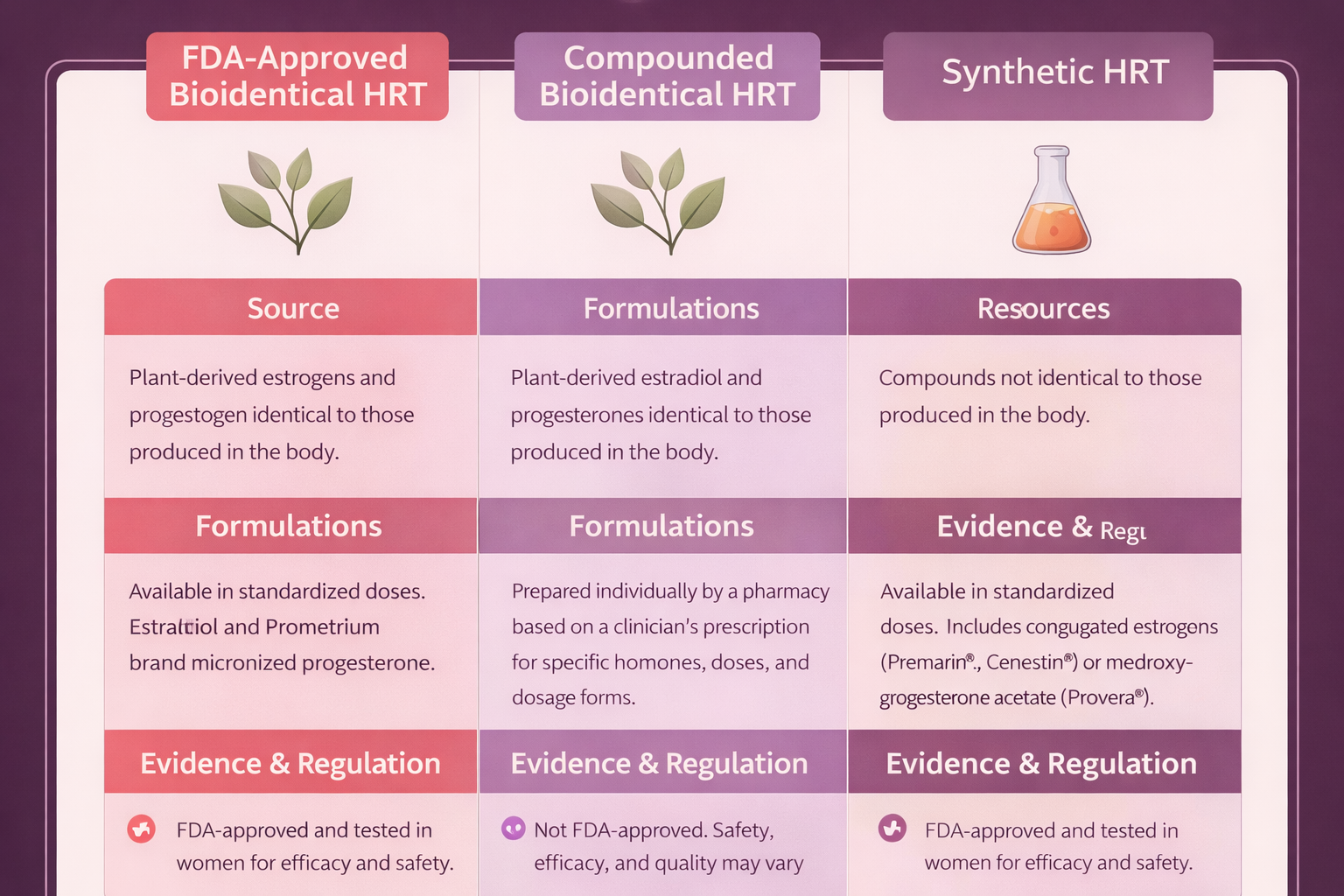
Bioidentical hormones are molecularly identical to human estradiol and progesterone. They are available as both FDA-approved products (estradiol patches, gels, micronized progesterone) and compounded preparations. The critical distinction is not bioidentical vs. synthetic — it is FDA-approved vs. compounded. FDA-approved bioidenticals undergo standardized testing for potency, purity, and consistency. Compounded preparations are not FDA-regulated and have documented variability in hormone content FDA 2020; Endocrine Society 2016. Synthetic hormones (conjugated equine estrogens, medroxyprogesterone acetate) have a different molecular structure but remain well-studied and appropriate for many patients WHI 2002; NAMS 2022. ACOG Committee Opinion #532 and the Endocrine Society both recommend FDA-approved formulations over compounded when an equivalent exists ACOG CO #532; Endocrine Society 2016. For a complete discussion of HRT candidacy, risk-benefit analysis, and monitoring, see our Menopause & HRT Guide.
The term “bioidentical” means that a hormone is molecularly identical to the hormones produced by the human body. Bioidentical estradiol (17β-estradiol) has the exact same chemical structure as the estradiol your ovaries produce. Bioidentical progesterone — sometimes called micronized progesterone — is structurally identical to endogenous progesterone.
This is a factual, chemical description. The molecules themselves are not proprietary, alternative, or controversial. Where the confusion begins is in how the term is used.
In clinical practice, “bioidentical” is simultaneously a scientific term and a marketing term, and the two meanings diverge in important ways:
Both FDA-approved pharmaceutical products and compounded pharmacy preparations can contain bioidentical hormones. The molecule itself is the same. What differs — dramatically — is the regulatory oversight, quality control, and evidence base behind how that molecule reaches you.
“Bioidentical” describes a molecule. It does not describe a level of safety, a manufacturing process, or a regulatory standard. Two products can both contain bioidentical estradiol — one FDA-approved with rigorous quality testing, one compounded with no standardized oversight. The molecule is the same; the assurance behind it is not.
All bioidentical hormones used in clinical practice are synthesized in a laboratory, typically derived from plant precursors (most commonly diosgenin from yams or soy). The term “natural” is often applied to bioidentical hormones, but this is misleading — the synthesis process is the same whether the end product is sold as an FDA-approved pharmaceutical or a compounded preparation. Neither product is “natural” in the sense of being found in nature in its final form.
The relevant question for patients is not “Is this hormone bioidentical?” but rather: “Is this product FDA-approved, and what is the evidence behind it?”
This is the distinction that matters most — and the one that is most frequently obscured in popular discussions of hormone therapy. Both FDA-approved products and compounded preparations can contain the same bioidentical molecule, but they differ in every other dimension that affects patient safety.
Several widely prescribed hormone therapy products are both bioidentical and FDA-approved. These are not niche or alternative — they are mainstream, first-line options used daily in evidence-based practice:
Every FDA-approved product on this list went through a rigorous approval process that includes demonstration of potency (the stated dose is what you receive), purity (free of contaminants), bioavailability (the drug is absorbed and reaches effective levels), stability (potency does not degrade before expiration), and consistency (batch-to-batch uniformity). These requirements are enforced by the FDA through current Good Manufacturing Practice (cGMP) regulations, with regular facility inspections and batch testing.
Compounded hormone preparations are mixed by compounding pharmacies according to a prescriber’s order. They serve a legitimate clinical role in specific circumstances — for example, when a patient needs a dose that is not commercially available, or has an allergy to an inactive ingredient in an FDA-approved product. However, compounded preparations:
A 2001 FDA analysis of compounded products found that 34% failed quality testing, compared to a 2% failure rate for FDA-approved products. More recent analyses continue to document significant variability. This is not an abstract regulatory concern — potency variability means a patient may receive substantially more or less hormone than prescribed, with direct implications for both efficacy and safety.
Many compounding pharmacies market “customized” hormone therapy based on salivary hormone level testing. The premise is that saliva testing can determine your precise hormonal needs and allow a compounding pharmacist to create a personalized formulation.
This approach is not supported by the evidence. ACOG, the Endocrine Society, and the North American Menopause Society (NAMS) all recommend against using salivary hormone levels to guide HRT dosing. The reasons are straightforward:
Dosing of hormone therapy is guided by symptom response and clinical assessment, not by attempting to match a laboratory number. For detailed information on monitoring protocols, see our Menopause & HRT Guide.
“Synthetic” in the context of hormone therapy typically refers to hormones whose molecular structure differs from the endogenous human hormone. The two most commonly discussed synthetic hormones are:
It is important to understand that “synthetic” does not mean “inferior” or “dangerous.” CEE and MPA are FDA-approved, rigorously tested, well-studied, and remain appropriate, effective options for many patients. They have the most extensive long-term safety data of any hormone therapy formulations, precisely because they were the agents used in the WHI and other landmark trials.
Most of what we know about HRT safety comes from studies of synthetic hormones. The WHI — the largest randomized trial of hormone therapy ever conducted — used CEE (Premarin) and MPA (Provera). When studies find that “HRT” carries a certain risk, those findings apply specifically to the formulations studied. They cannot be automatically generalized to all HRT, and they cannot be automatically dismissed for bioidentical formulations that were not part of the trial.
The Women’s Health Initiative (WHI) fundamentally changed how clinicians prescribe hormone therapy. The CEE + MPA arm of the WHI showed a small increase in breast cancer risk, a small increase in cardiovascular events (in women who started HRT more than 10 years after menopause), a decrease in hip fracture, and a decrease in colorectal cancer.
Critically, the CEE-alone arm (in women who had a hysterectomy and did not take MPA) showed no increase in breast cancer risk — and in extended follow-up, showed a statistically significant decrease in breast cancer incidence. This finding has led many researchers and clinicians to focus on the role of the progestogen component in modulating breast cancer risk.
Some evidence suggests that micronized progesterone (the bioidentical progestogen) may carry a lower breast cancer risk than MPA (the synthetic progestin used in the WHI). The EPIC-E3N French cohort study found that combined HRT with micronized progesterone had no statistically significant increase in breast cancer risk over a mean follow-up of 8.1 years, whereas regimens using synthetic progestins did show an increase. However, this was an observational study, not a randomized trial, and the evidence remains insufficient for definitive conclusions.
What we can say: There are biologically plausible reasons to consider micronized progesterone or transdermal estradiol over oral CEE + MPA for certain patient profiles. These are nuanced, individualized decisions that belong in the context of a comprehensive risk-benefit discussion. For that framework, see our Menopause & HRT Guide.
| Dimension | FDA-Approved Bioidentical | Compounded Bioidentical | Synthetic (CEE/MPA) |
|---|---|---|---|
| FDA Regulation | Yes — full pre-market review | No — pharmacy-level oversight only | Yes — full pre-market review |
| Potency Consistency | Standardized; batch-to-batch uniformity required by cGMP | Variable; studies document 67–150% of labeled dose | Standardized; batch-to-batch uniformity required by cGMP |
| Purity Testing | Required — contaminant limits enforced | Pharmacy-dependent; not standardized | Required — contaminant limits enforced |
| Safety Data | Robust — clinical trial data required for approval; post-market surveillance | Limited — no pre-market clinical trials; inferred from FDA-approved bioidentical data | Extensive — WHI and decades of additional trial data |
| Efficacy Data | Demonstrated in clinical trials | Not independently demonstrated; assumed from bioidentical molecule data | Demonstrated in clinical trials |
| Molecular Structure | Identical to human hormones (17β-estradiol, progesterone) | Identical to human hormones (same molecules, different manufacturing) | Different from human hormones (equine estrogens, synthetic progestins) |
| Typical Cost | Moderate — many covered by insurance; generics available | Variable — often not covered by insurance; may be higher out-of-pocket | Low to moderate — generics widely available; typically covered |
| Customization | Fixed doses and delivery systems; multiple options available | Flexible dosing and combinations; custom formulations possible | Fixed doses; fewer delivery options than bioidentical estradiol |
| Patient Labeling | Standardized — FDA-approved package inserts with warnings, contraindications, interactions | Not standardized — no required patient information insert | Standardized — FDA-approved package inserts with warnings, contraindications, interactions |
| ACOG/Endocrine Society Position | Recommended when bioidentical is preferred | Recommended only when FDA-approved equivalent unavailable | Appropriate for many patients; extensive evidence base |

The comparison table illustrates a consistent pattern: FDA-approved products — whether bioidentical or synthetic — share the critical features of standardized regulation, demonstrated potency, proven efficacy, and long-term safety data. Compounded preparations, despite containing the same bioidentical molecules, lack these assurances not because of the hormone itself but because of the manufacturing and regulatory framework.
This does not mean compounded hormones are always inappropriate. It means that the decision to use a compounded preparation should be made for a specific clinical reason, not on the assumption that compounded products are “more natural” or “safer” than FDA-approved alternatives.
The major professional organizations that guide hormone therapy practice in the United States have issued clear, consistent position statements on this topic. These are not opinions — they are evidence-based consensus recommendations developed through systematic review.
Compounded Bioidentical Menopausal Hormone Therapy (originally published 2012; reaffirmed 2024). Key positions:
Bioidentical Hormones. Key positions:
If your provider recommends bioidentical hormones, the first question to ask is whether they are recommending an FDA-approved product or a compounded preparation. If an FDA-approved bioidentical option exists for your needs (and in most cases it does), major medical organizations recommend starting there. If compounding is recommended, ask why — there should be a specific clinical reason, such as an allergy or a dose requirement that cannot be met by available products.
The North American Menopause Society (NAMS) 2022 Hormone Therapy Position Statement aligns with ACOG and the Endocrine Society, emphasizing that FDA-approved hormone therapy formulations are recommended and that compounded products should be reserved for situations where commercially available products cannot meet the patient’s needs. NAMS explicitly notes that compounded preparations “have not been shown to be more efficacious or safer than FDA-approved therapies.”
Taken together, these three organizations — representing the breadth of menopause medicine, gynecology, and endocrinology — deliver a consistent message: the evidence does not support choosing compounded bioidentical hormones over FDA-approved alternatives in routine clinical practice.
For a full discussion of how these recommendations factor into individualized treatment decisions, including candidacy criteria, risk stratification, and monitoring protocols, see our comprehensive Menopause & HRT Guide. If you are experiencing symptoms that may indicate you are entering the menopausal transition, our Perimenopause Guide covers staging, symptom identification, and when to seek evaluation.
Choosing the right hormone therapy formulation is a decision that should be guided by evidence, not marketing. Dr. Broad takes the time to explain your options, review the data, and develop a plan that reflects your individual risk profile and goals.
Schedule a Consultation →