IUD Insertion in Newport Beach — Types, Procedure & Cost (2026) | Broad Medical Group (949) 720-9848
Birth Control · Newport Beach · 2026

IUD Birth Control
Types, Procedure & What to Expect

Over 99% effective. Up to 10 years of protection. One office visit.

The IUD is the most effective reversible birth control available — and one of the most popular. Five FDA-approved options let you choose hormonal or hormone-free, 3 years or 10. This guide compares every IUD, explains the insertion procedure, and covers cost and insurance so you can make a confident decision.

◆ Short Answer

The Canonical Answer

The intrauterine device (IUD) is a small, T-shaped device placed in the uterus that provides long-acting, reversible contraception with over 99% effectiveness. Five FDA-approved IUDs are available: four hormonal — Mirena (up to 8 years), Kyleena (up to 5 years), Liletta (up to 8 years), and Skyla (up to 3 years) — and one copper: Paragard (up to 10 years, hormone-free) ACOG PB #186. ACOG recommends IUDs and implants as first-line contraceptives for most women, including adolescents and nulliparous women ACOG CO #642. Insertion is an office procedure taking 5–10 minutes. Most insurance plans cover IUDs at no cost under the ACA preventive care mandate. At Broad Medical Group, Dr. Jennifer Broad provides IUD consultation, insertion, and removal for women in Newport Beach and Orange County.

Dr. Jennifer Broad headshot
Medically reviewed by Dr. Jennifer Broad, MD, FACOG Board-Certified Obstetrician-Gynecologist · Newport Beach, CA
Last reviewed: April 2026 Next review: October 2026
Modern consultation room at Broad Medical Group â€

IUD Options: Which One Is Right for You?

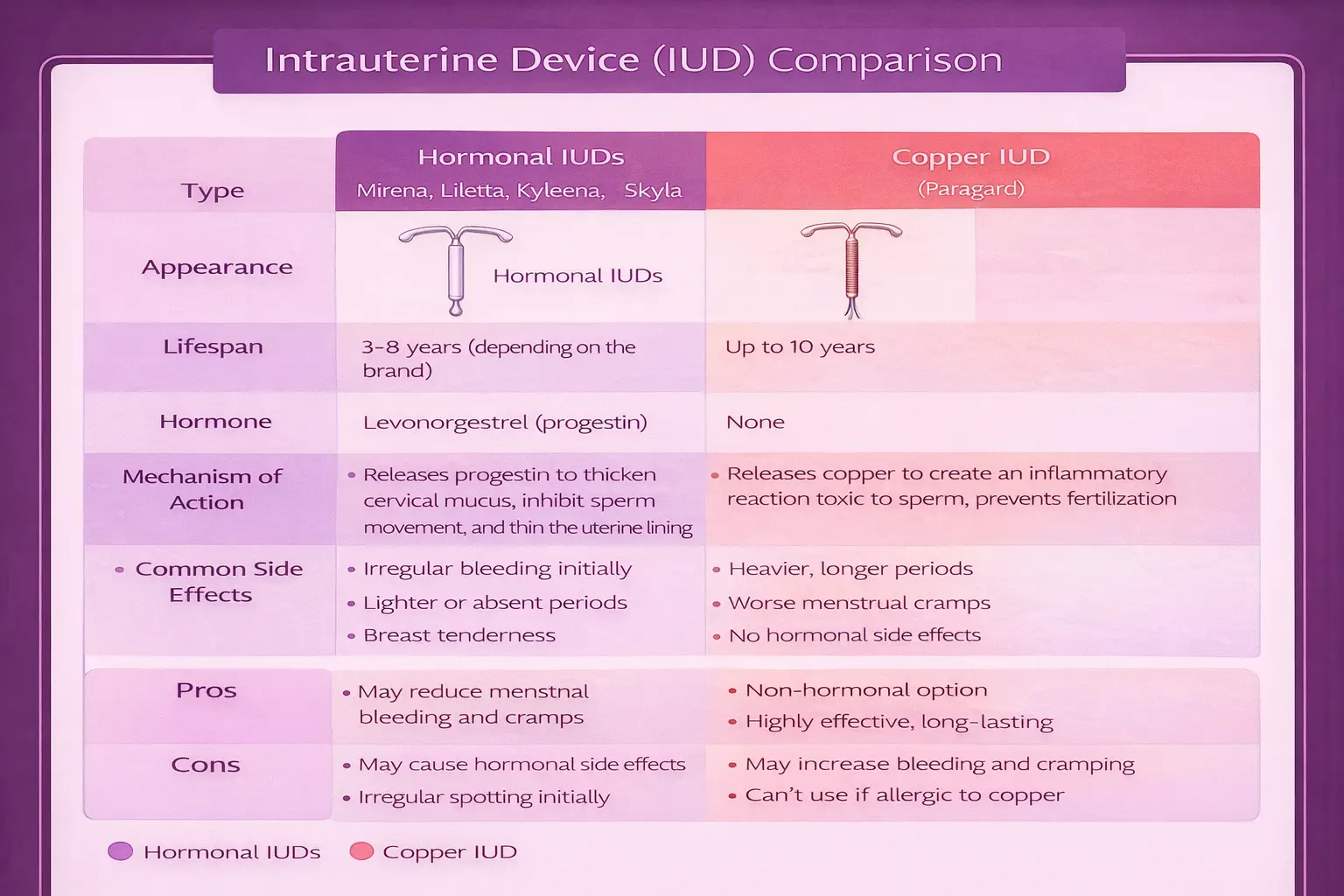
There are five FDA-approved intrauterine devices available in the United States, and the best choice depends on your health goals, bleeding preferences, and how long you want protection. The four hormonal IUDs release levonorgestrel (a progestin) locally within the uterus, which thins the uterine lining and thickens cervical mucus. The one non-hormonal IUD uses copper to create an environment that is toxic to sperm.

Hormonal IUDs

Mirena contains 52 mg of levonorgestrel and is FDA-approved for up to 8 years of contraception. It is also FDA-approved for the treatment of heavy menstrual bleeding (menorrhagia), making it a dual-purpose device. Most women experience significantly lighter periods, and approximately 20% stop having periods altogether by one year. Mirena is the most widely studied IUD in the world.

Kyleena contains 19.5 mg of levonorgestrel and is approved for up to 5 years. Its lower hormone dose and smaller frame make it a popular choice for women who want hormonal contraception with fewer systemic effects. Periods typically become lighter but are less likely to stop completely compared to Mirena.

Liletta contains 52 mg of levonorgestrel — the same dose as Mirena — and is approved for up to 8 years. It was developed through a public-private partnership to improve IUD access and is often available at lower cost through public health programs and Title X clinics.

Skyla contains 13.5 mg of levonorgestrel, the lowest dose of any hormonal IUD, and is approved for up to 3 years. It has the smallest frame of all IUDs and the narrowest insertion tube, which may be preferred by nulliparous women or those with a smaller uterine cavity.

Non-Hormonal IUD

Paragard is the only hormone-free IUD available in the United States. It is wrapped in copper wire, which creates a local inflammatory response that is toxic to sperm and prevents fertilization. Paragard is approved for up to 10 years and is the right choice for women who want long-term, hormone-free contraception. It can also be used as emergency contraception if inserted within 5 days of unprotected intercourse — the most effective form of emergency contraception available.

The trade-off: Paragard may increase menstrual bleeding and cramping, particularly in the first 3–6 months. This typically improves over time, but women with already-heavy periods may prefer a hormonal IUD instead.

ACOG Guideline

ACOG recommends long-acting reversible contraceptives (LARCs) — IUDs and implants — as first-line contraceptive options for most women, including adolescents and nulliparous women. LARCs have the highest continuation rates and lowest failure rates of all reversible contraceptive methods. ACOG Committee Opinion No. 642, 2015; reaffirmed 2023

IUD Type Duration Size (mm) Bleeding Pattern FDA Indication Best Suited For
Mirena Hormonal (52 mg LNG) Up to 8 years 32 × 32 Significantly lighter; ~20% amenorrhea at 1 yr Contraception + heavy menstrual bleeding Women wanting lighter periods or treating heavy bleeding
Kyleena Hormonal (19.5 mg LNG) Up to 5 years 28 × 30 Lighter periods; ~12% amenorrhea at 1 yr Contraception Women wanting lower hormone dose or smaller device
Liletta Hormonal (52 mg LNG) Up to 8 years 32 × 32 Similar to Mirena; significantly lighter Contraception Cost-conscious patients; clinic/public health settings
Skyla Hormonal (13.5 mg LNG) Up to 3 years 28 × 30 Lighter; ~6% amenorrhea at 1 yr Contraception Nulliparous women; smallest uterine cavity
Paragard Copper (non-hormonal) Up to 10 years 32 × 36 Heavier, longer periods initially; improves over time Contraception + emergency contraception Women wanting hormone-free contraception
Side-by-side visual comparison of all five IUD types - Mirena, Kyleena, Liletta, Skyla, and Paragard - showing relative size, hormone content, and duration
All five FDA-approved IUDs compared. Hormonal IUDs shown in proportion to actual size; duration and hormone content indicated.

Who Is a Good Candidate?

The short answer: almost any woman of reproductive age. IUDs are safe and appropriate for a much wider range of women than many patients — and even some providers — realize. The outdated belief that IUDs are only for women who have had children is not supported by current evidence.

Nulliparous Women (Never Been Pregnant)

Women who have never been pregnant are excellent IUD candidates. ACOG specifically recommends IUDs as first-line contraception for nulliparous women, including adolescents ACOG CO #642. Smaller IUDs like Kyleena and Skyla were designed with narrower insertion tubes to accommodate women who have not had a vaginal delivery. Studies consistently show high satisfaction rates and low expulsion rates in nulliparous women.

Postpartum Women

IUDs can be inserted immediately after delivery (within 10 minutes of placental delivery), at the postpartum visit (typically 4–6 weeks), or at any time thereafter. Immediate postpartum insertion has a slightly higher expulsion rate but eliminates the risk of an unintended pregnancy before the follow-up visit. Both timing options are safe and effective, and the decision is made jointly between you and Dr. Broad based on your individual circumstances.

Breastfeeding Women

All IUDs are safe during breastfeeding. Hormonal IUDs release progestin locally at doses far too low to affect milk supply or infant development. Paragard contains no hormones at all. The WHO classifies all IUDs as Category 1 (no restriction) for breastfeeding women WHO MEC, 2015.

Contraindications

While most women are candidates, IUDs are not appropriate in the following situations:

  • Active pelvic infection (pelvic inflammatory disease, cervicitis, or endometritis) — treat first, then insert
  • Distorted uterine cavity from fibroids or congenital anomalies that would prevent proper IUD placement
  • Wilson’s disease (copper metabolism disorder) — contraindication for Paragard only
  • Copper allergy — contraindication for Paragard only
  • Unexplained vaginal bleeding — evaluate before insertion
  • Cervical or uterine cancer — active, untreated malignancy
  • Current pregnancy

If you are unsure whether you are a candidate, Dr. Broad will assess your medical history, perform any necessary evaluation, and recommend the best option for you.

The Insertion Procedure: What to Expect

IUD insertion is a brief office procedure performed right in the exam room — no operating room, no sedation, no downtime. The entire process typically takes 5–10 minutes from start to finish. Many patients have their IUD placed during a well-woman exam visit, combining two appointments into one.

Before the Procedure

  • You may be asked to take a pregnancy test on the day of insertion.
  • Insertion can be performed at any point in your menstrual cycle as long as pregnancy has been excluded.
  • No fasting is required. Eat normally before your appointment.
  • Take 600–800 mg of ibuprofen (Advil, Motrin) 30–60 minutes before your appointment to reduce cramping during and after insertion.

During the Procedure

  1. Speculum placement. A speculum is inserted into the vagina, identical to what is used during a Pap smear.
  2. Cervical cleaning. The cervix is cleaned with an antiseptic solution.
  3. Uterine sounding. A thin instrument measures the depth and direction of the uterus. This takes a few seconds and may cause a brief cramp.
  4. IUD insertion. The IUD is loaded into a thin insertion tube and passed through the cervical canal into the uterus. The arms of the T open, and the tube is withdrawn. This is the step that causes the most cramping — it lasts approximately 15–30 seconds.
  5. String trimming. The IUD strings are trimmed to approximately 3 cm beyond the cervix. These strings allow you to check placement and enable easy removal later.

Pain and Discomfort

Most women describe the insertion as a strong menstrual cramp that lasts less than a minute. Pain levels vary — some women find it very tolerable, others find it more intense but brief. The discomfort resolves quickly, and most patients walk out of the office feeling fine. No anesthesia is typically needed, though Dr. Broad can discuss additional pain management options if you have concerns.

Patient Tip

Take 600–800 mg of ibuprofen 30–60 minutes before your insertion appointment. This reduces prostaglandin-mediated cramping during the procedure and during the first few hours after. Avoid taking ibuprofen on an empty stomach. If you cannot take ibuprofen, let Dr. Broad’s office know when scheduling so they can recommend an alternative.

After Insertion: What’s Normal

Your body needs time to adjust to the IUD. Knowing what to expect helps you distinguish normal adjustment from signs that need medical attention.

The First Few Days

Mild to moderate cramping is normal for 1–2 days after insertion. Ibuprofen and a heating pad are usually sufficient. Light spotting is also common. Most women return to normal activities the same day or the next day.

The First 1–3 Months (Adjustment Period)

Hormonal IUDs (Mirena, Kyleena, Liletta, Skyla): Expect irregular bleeding and spotting during the first 3–6 months. This is the most common reason women consider early removal — but it almost always resolves. By 6 months, most women have significantly lighter periods. Many have only light spotting, and some stop having periods altogether (this is medically safe and not a cause for concern).

Paragard (copper IUD): Periods may be heavier, longer, and more crampy for the first 3–6 months. This is the most common side effect of Paragard. For most women, periods gradually return closer to their pre-IUD pattern. However, some degree of increased menstrual flow may persist.

Follow-Up

Dr. Broad recommends a string check at 4–6 weeks after insertion to confirm the IUD is properly positioned. You will also learn how to check your own strings at home — a simple, two-second check you can do monthly if you wish (though it is not strictly required).

When to Call the Office

Contact Broad Medical Group at (949) 720-9848 if you experience any of the following after IUD insertion:

  • Severe pelvic pain that is not relieved by ibuprofen
  • Heavy bleeding — soaking through a pad or tampon every hour for 2 or more hours
  • Fever (temperature above 100.4°F / 38°C)
  • Foul-smelling vaginal discharge
  • You cannot feel the IUD strings or they feel significantly longer or shorter than before

These symptoms are uncommon but may indicate infection, expulsion, or perforation, which require prompt evaluation.

IUD Removal: Simple and Quick

IUD removal is one of the simplest procedures in gynecology. Dr. Broad grasps the IUD strings with a small instrument and applies gentle traction — the arms of the T fold upward, and the device slides out through the cervix. The entire process typically takes less than 1 minute.

Most women feel a brief cramp during removal, similar to the sensation during a Pap smear. No anesthesia is needed.

Important Points About Removal

  • Fertility returns immediately. You can become pregnant as early as your next cycle after removal. If you do not want to become pregnant, start an alternative contraceptive method before or at the time of removal.
  • You are not “locked in.” You can have your IUD removed at any time, for any reason — you do not have to wait until it expires. Some women use an IUD for just one year before deciding to try for pregnancy.
  • Same-visit replacement. If you want to continue with an IUD, a new device can be inserted at the same visit immediately after the old one is removed.

Cost and Insurance Coverage

With Insurance

Under the Affordable Care Act (ACA) preventive care mandate, most private insurance plans are required to cover FDA-approved contraceptive methods — including IUDs — at no out-of-pocket cost (no copay, no deductible). This includes the device itself, the insertion procedure, and the follow-up visit.

In practice, this means that most insured patients pay $0 for their IUD. However, coverage details vary by plan, and some grandfathered or employer-exempt plans may not comply with the mandate. We recommend calling your insurance company or contacting our office before your appointment to confirm coverage.

Without Insurance

Without insurance, the total cost for an IUD (device + insertion) typically ranges from $500 to $1,300, depending on the specific device. Liletta is generally the most affordable option. Self-pay pricing is available — contact our office for current rates.

Insurance Plans Accepted

Broad Medical Group accepts the following insurance plans:

Aetna
Anthem Blue Cross
Blue Shield of CA
CalOptima
Health Net
Medi-Cal
Medicare
United Healthcare

Not sure about your plan? Call (949) 720-9848 and our team will verify your benefits before your appointment so there are no surprises.

IUD vs. Other Birth Control Methods

How does the IUD compare to other popular contraceptive methods? The table below provides a quick, evidence-based comparison to help you understand your options. Dr. Broad can discuss the advantages and trade-offs of each method at your contraception consultation.

Method Effectiveness (typical use) Duration Hormones Reversibility Maintenance
IUD (hormonal) >99% 3–8 years Progestin (local) Immediate None after insertion
IUD (copper) >99% Up to 10 years None Immediate None after insertion
Implant (Nexplanon) >99% Up to 3 years Progestin (systemic) Immediate None after insertion
Combined Pill 91% Daily Estrogen + progestin Immediate Daily pill at same time
Injection (Depo-Provera) 94% 3 months Progestin (systemic) Delayed (6–12 months) Office visit every 3 months
Vaginal Ring (NuvaRing) 91% Monthly Estrogen + progestin Immediate Replace every 3–4 weeks
Patch (Xulane) 91% Weekly Estrogen + progestin Immediate Change weekly for 3 weeks

The IUD’s key advantage is the combination of top-tier effectiveness with zero daily maintenance. Unlike the pill, there is nothing to remember each day, no refills to pick up, and no risk of user error. Once it is placed, it works continuously until you decide to have it removed.

Key Takeaways
  • IUDs are over 99% effective — the most effective reversible contraception available, recommended as first-line by ACOG.
  • Five options are FDA-approved: Mirena (8 yr), Kyleena (5 yr), Liletta (8 yr), Skyla (3 yr), and Paragard copper (10 yr, hormone-free).
  • You do NOT need to have had children. ACOG recommends IUDs for nulliparous women and adolescents.
  • Insertion takes 5–10 minutes in the office, with no sedation or downtime required. Take ibuprofen beforehand to reduce cramping.
  • Most insurance covers IUDs at $0 out-of-pocket under the ACA preventive care mandate. Call to verify your specific plan.
  • Removal is simple and immediate. Fertility returns right away — you are never locked in.
  • Broad Medical Group accepts Aetna, Anthem, Blue Shield, CalOptima, Health Net, Medi-Cal, Medicare, and United Healthcare. Call (949) 720-9848 to schedule.

References & Clinical Sources

  1. American College of Obstetricians and Gynecologists. Practice Bulletin No. 186: Long-Acting Reversible Contraception: Implants and Intrauterine Devices. Obstetrics & Gynecology, 130(5), e251–e269. 2017.
  2. American College of Obstetricians and Gynecologists. Committee Opinion No. 642: Increasing Access to Contraceptive Implants and Intrauterine Devices to Reduce Unintended Pregnancy. Obstetrics & Gynecology, 126(4), e44–e48. 2015. Reaffirmed 2023.
  3. World Health Organization. Medical Eligibility Criteria for Contraceptive Use, 5th edition. Geneva: WHO, 2015.
  4. Curtis KM, Tepper NK, Jatlaoui TC, et al. U.S. Medical Eligibility Criteria for Contraceptive Use, 2016. MMWR Recommendations and Reports, 65(3), 1–103. 2016.
  5. Secura GM, Allsworth JE, Madden T, Mullersman JL, Peipert JF. The Contraceptive CHOICE Project: reducing barriers to long-acting reversible contraception. American Journal of Obstetrics and Gynecology, 203(2), 115.e1–115.e7. 2010.

Related Resources

Your Birth Control. Your Choice. One Visit.

Ready to discuss which IUD is right for you? Want to have it placed at your next visit? Dr. Broad is accepting new patients in Newport Beach and Orange County. Most insurance plans cover the IUD at no cost.

Broad Medical Group — Newport Beach, California

Medical Disclaimer: This content is for educational purposes only and does not constitute medical advice, diagnosis, or treatment. Consult Dr. Jennifer Broad or your healthcare provider for guidance specific to your situation. Current as of April 2026. If you are experiencing a medical emergency, call 911 immediately.