Not guesswork. Not marketing. Clinical evidence.
A comprehensive clinical resource for understanding menopause staging, HRT candidacy, risk-benefit analysis, treatment options, and monitoring protocols — grounded in current ACOG guidelines, the WHI reanalysis, the 2022 NAMS position statement, and the FDA’s 2025 labeling update.

Menopause is the permanent cessation of menstruation, clinically defined by the STRAW+10 staging system as 12 consecutive months of amenorrhea resulting from loss of ovarian follicular activity. The average age of natural menopause in the United States is 51. Hormone replacement therapy (HRT) is the most effective treatment for vasomotor symptoms (hot flashes, night sweats) and genitourinary syndrome of menopause NAMS 2022. Current evidence — including the WHI reanalysis and multiple subsequent studies — demonstrates that HRT initiated within 10 years of menopause onset or before age 60 is associated with cardiovascular benefit, not risk, in appropriately selected patients Manson et al., JAMA 2013. The FDA’s 2025 labeling update reflects this refined understanding of timing-dependent safety. HRT remains contraindicated in women with active breast cancer, unexplained vaginal bleeding, active liver disease, or history of venous thromboembolism. At Broad Medical Group in Newport Beach, Dr. Jennifer Broad provides individualized menopause management using STRAW+10 staging, evidence-based candidacy criteria, and structured monitoring protocols.
The question is not whether HRT is safe. The question is: for whom, when, what type, and for how long.
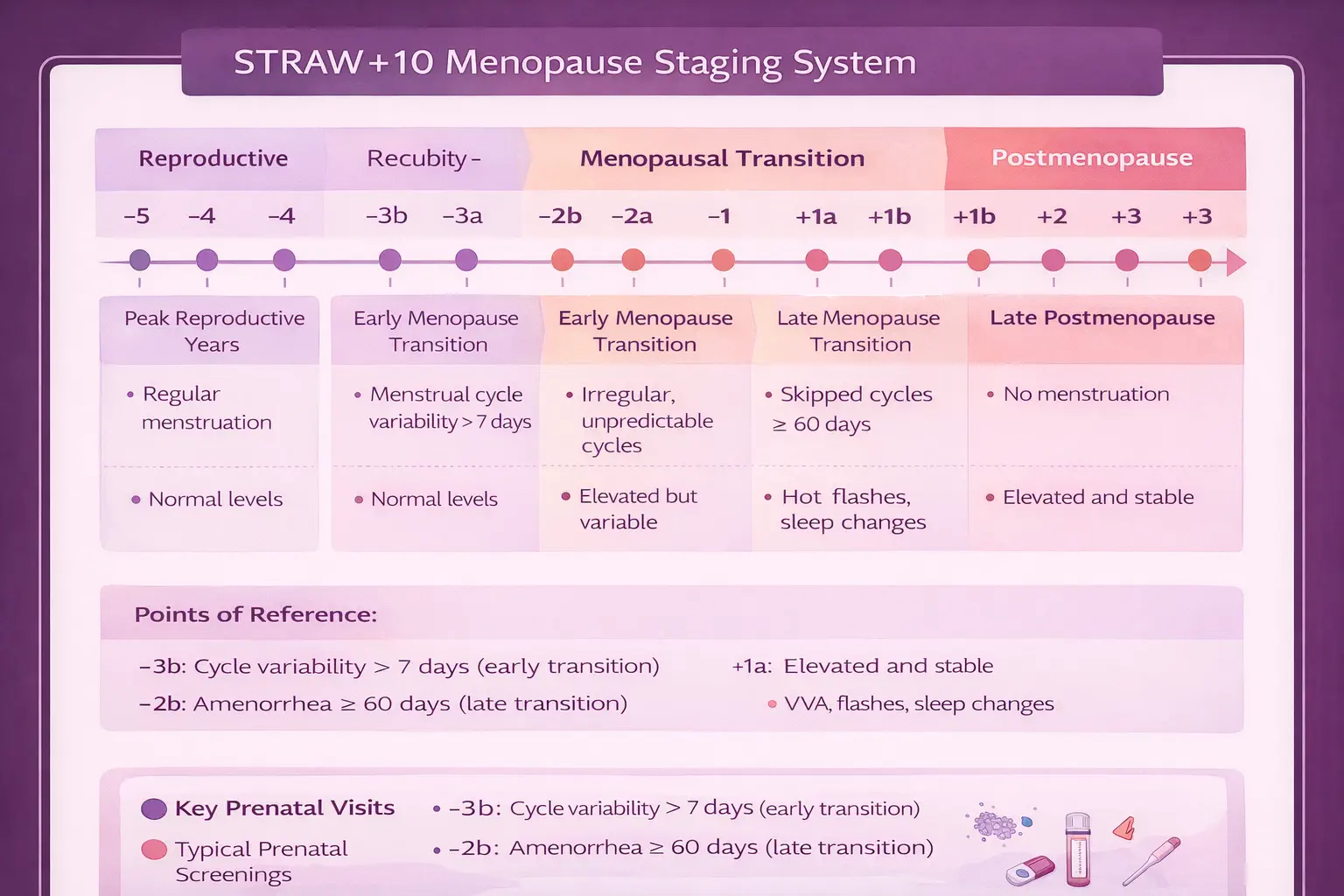
The STRAW+10 system is the internationally recognized clinical standard for staging reproductive aging. It replaces imprecise terms like “premenopause” with measurable criteria based on menstrual cycle patterns, FSH levels, and AMH levels. Knowing your stage determines what treatment options are appropriate — and when. Dr. Jennifer Broad uses STRAW+10 staging at Broad Medical Group to precisely assess each patient’s position in the menopausal transition.
Reproductive aging is not a single event. It is a continuum that spans years — sometimes a decade or more — before the final menstrual period. The Stages of Reproductive Aging Workshop + 10 STRAW+10 divides this continuum into clearly defined stages based on objective clinical criteria, published in the Journal of Clinical Endocrinology & Metabolism by Harlow et al. in 2012.
Understanding where you are in this staging system is the foundation of effective menopause management. A woman in the early menopausal transition (Stage -2) has different treatment needs than a woman five years into postmenopause (Stage +1c). The staging also determines whether the “timing window” for HRT initiation is still open.
| Stage | Name | Menstrual Criteria | Hormonal Markers | Duration |
|---|---|---|---|---|
| -2 | Early Transition | Variable cycle length (≥7 days different from normal) | FSH rising, variable; AMH declining | Variable |
| -1 | Late Transition | Intervals of ≥60 days amenorrhea | FSH >25 IU/L; AMH low/undetectable | 1–3 years |
| +1a | Early Postmenopause | First 2 years after final menstrual period (FMP) | FSH continues to rise; estradiol declining | 2 years |
| +1b | Early Postmenopause | 3–6 years after FMP | FSH stabilizing at elevated levels | 3–4 years |
| +1c / +2 | Late Postmenopause | >6 years after FMP | FSH stable, elevated; estradiol stable, low | Remainder of life |
STRAW+10 staging applies to women undergoing natural menopause. Women who have undergone surgical menopause (bilateral oophorectomy) or have had menopause induced by chemotherapy or radiation experience an abrupt transition and are staged differently. If you are experiencing symptoms of the menopausal transition, see our Perimenopause Guide for detailed symptom identification and when to seek evaluation.
HRT candidacy is not a yes-or-no question. It is an individualized risk-benefit assessment based on symptom severity, time since menopause, cardiovascular risk profile, breast cancer risk, and thrombotic history. The NAMS 2022 position statement provides the clearest framework for making this determination. At Broad Medical Group, Dr. Jennifer Broad applies this framework to every patient individually. Not sure where to start? Our guide on when to see a menopause specialist can help.
The NAMS 2022 position statement affirms: “For symptomatic women who are within 10 years of menopause onset and have no contraindications, the benefits of hormone therapy most likely exceed the risks for treatment of bothersome vasomotor symptoms and prevention of bone loss.” This represents the current clinical consensus and is the framework applied at Broad Medical Group.
The 2002 WHI study created widespread fear about HRT safety. Subsequent reanalysis has fundamentally changed that picture. The original study enrolled women with an average age of 63 — well past the optimal initiation window. When stratified by age and time since menopause, the data tell a different story. Women who start HRT earlier experience benefit, not harm.
The timing hypothesis is the most important concept in modern HRT decision-making. It holds that the effects of HRT on the cardiovascular system depend on when therapy is initiated relative to menopause onset. The WHI reanalysis by Manson et al. JAMA 2013 demonstrated that women who began estrogen therapy within 10 years of menopause had a statistically significant reduction in coronary heart disease and all-cause mortality, while women who initiated therapy 20+ years after menopause had increased cardiovascular risk.
This distinction is critical and explains why early WHI results appeared negative: the study population was predominantly older women who had been postmenopausal for many years. The timing hypothesis has since been supported by the Danish Osteoporosis Prevention Study, the Kronos Early Estrogen Prevention Study (KEEPS), and the Early versus Late Intervention Trial with Estradiol (ELITE).
| Outcome | Within Timing Window (<10 yr / <60) | Outside Timing Window (>10 yr / >60) | Evidence Source |
|---|---|---|---|
| Vasomotor Symptoms | 75–80% reduction | Effective but higher risk-benefit ratio | NAMS 2022 |
| Coronary Heart Disease | Reduced risk (HR 0.68 for ET alone) | Neutral to increased risk | Manson, JAMA 2013 |
| All-Cause Mortality | Reduced (HR 0.69 for ages 50–59) | Neutral | Manson, JAMA 2013 |
| Bone Fracture | Reduced (33% reduction in hip fracture) | Reduced | WHI, JAMA 2002 |
| Breast Cancer (E+P) | Small increased risk after 5+ years of combined E+P | Increased risk | WHI; Beral, Lancet 2019 |
| Breast Cancer (E alone) | No increase; possible decrease | Neutral | WHI ET arm, JAMA 2020 |
| Venous Thromboembolism | Increased with oral; not increased with transdermal | Increased with oral | Canonico, BMJ 2008 |
| Colorectal Cancer | Reduced risk with combined E+P | Reduced | WHI, JAMA 2002 |
| Type 2 Diabetes | Reduced incidence | Reduced | Margolis, Diabetologia 2004 |
Combined estrogen-progestogen therapy (E+P) carries a small but real increase in breast cancer risk after approximately 5 years of continuous use. This risk is approximately 8 additional cases per 10,000 women per year WHI, JAMA 2002 — comparable to the risk increase associated with one glass of wine per day or obesity. Estrogen-only therapy in women who have had a hysterectomy does not carry this increased breast cancer risk and may be protective. Route of administration matters: transdermal estrogen avoids first-pass hepatic metabolism and does not increase venous thromboembolism risk Canonico, BMJ 2008.
The FDA’s 2025 update to HRT product labeling reflects two decades of post-WHI evidence. The revised labeling acknowledges the timing-dependent nature of cardiovascular risk and the distinction between different HRT formulations, routes, and regimens. This represents a significant shift from the blanket warnings that followed the original 2002 WHI publication and validates the approach that menopause specialists have been using based on accumulating evidence.
Estrogen has protective effects on healthy arterial endothelium. When initiated early (before atherosclerotic plaque has developed), HRT maintains vascular health. When initiated late (after plaque is established), estrogen may destabilize existing plaque. This biological mechanism explains the divergent outcomes between younger and older initiators in the WHI and subsequent studies.
HRT is not a single therapy. It is a framework of options that vary by hormone type, route of administration, dose, and regimen. The right combination depends on whether you have a uterus, your symptom profile, your risk factors, and your preferences. Dr. Jennifer Broad customizes every treatment plan to the individual patient.
| Route | Forms | Advantages | Considerations |
|---|---|---|---|
| Transdermal | Patch, gel, spray | Avoids first-pass liver metabolism; no increased VTE risk; stable hormone levels | Preferred for women with elevated thrombotic risk, hypertriglyceridemia, or liver concerns |
| Oral | Tablets (estradiol, CEE) | Well-studied; convenient; multiple formulations available | First-pass hepatic effect increases VTE risk and affects lipid/clotting factor production |
| Vaginal | Cream, tablet, ring, insert | Targeted local effect; minimal systemic absorption; no progestogen needed in most cases | Does not treat vasomotor symptoms; for genitourinary symptoms only |
Transdermal estrogen is increasingly preferred as the first-line route for systemic HRT. It provides stable estrogen levels without the hepatic first-pass effect, which means it does not increase the risk of blood clots or significantly affect triglyceride levels. If you have risk factors for thrombosis, migraine with aura, gallbladder disease, or hypertriglyceridemia, transdermal delivery is particularly advantageous. Discuss delivery route options with Dr. Broad to determine the best fit for your profile.
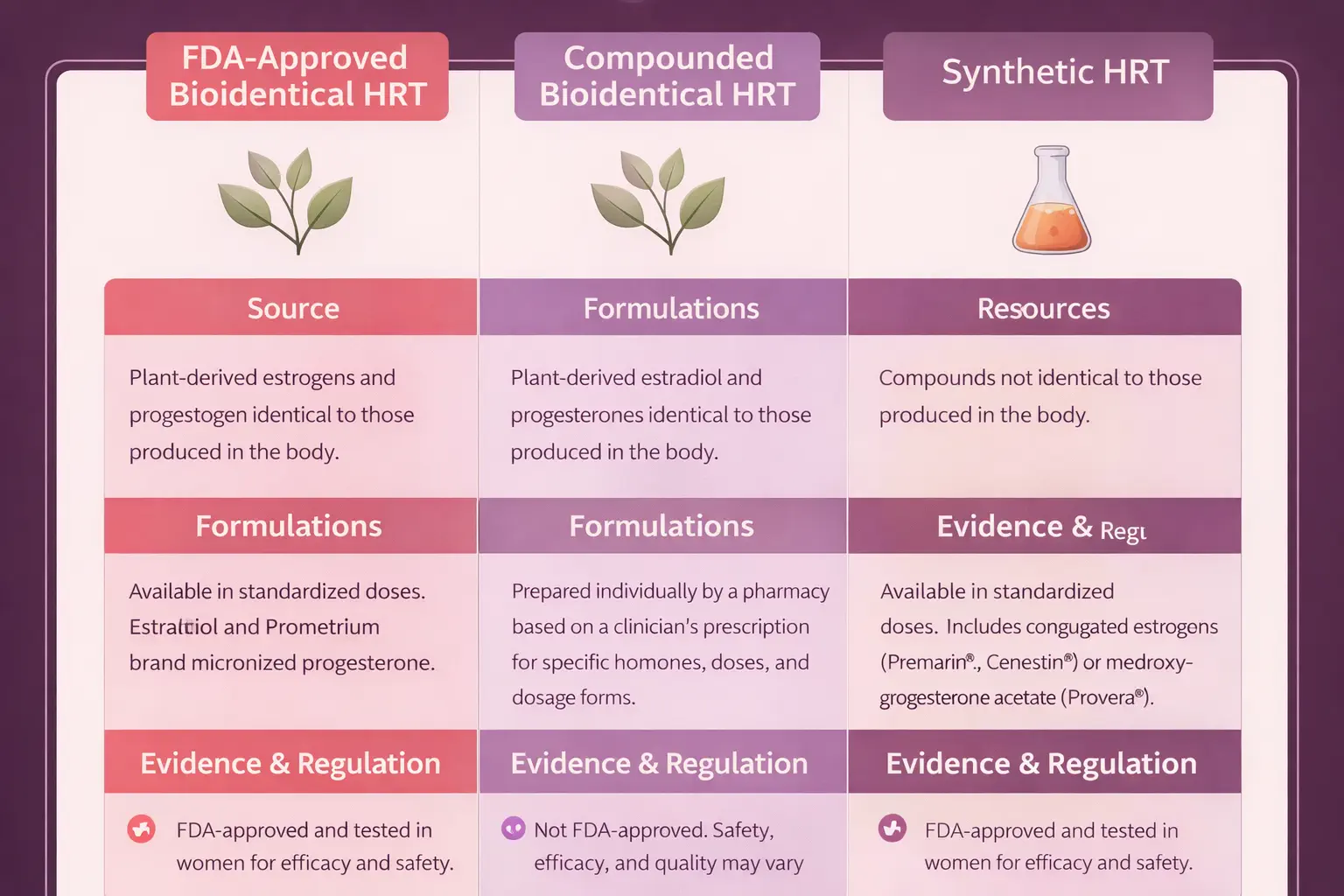
For a detailed comparison of FDA-approved bioidentical formulations versus compounded preparations, including the evidence on safety, potency, and regulatory status, see our dedicated resource: Bioidentical vs. Synthetic HRT — What the Evidence Says.
HRT is not a prescription you fill once and forget. Effective menopause management requires structured monitoring to ensure the therapy remains appropriate, the dose is optimized, symptoms are controlled, and no new risk factors have emerged. At Broad Medical Group, Dr. Jennifer Broad follows a defined monitoring protocol for every HRT patient.
| Timepoint | Assessments | Purpose |
|---|---|---|
| Baseline (Pre-HRT) | Comprehensive history, symptom assessment, cardiovascular risk evaluation, breast cancer risk assessment (Tyrer-Cuzick or similar), mammogram, BMD (if indicated), lipid panel, liver function, blood pressure | Establish candidacy, identify contraindications, document baseline risk |
| 3-Month Follow-Up | Symptom response evaluation, side effect assessment, blood pressure, dose adequacy review | Confirm therapy is effective, adjust dose/route if needed, address early side effects |
| Annual Review | Symptom reassessment, mammogram, BMD (per USPSTF schedule), lipid panel, blood pressure, breast exam, pelvic exam, reassessment of ongoing candidacy | Verify continued appropriateness, screen for new contraindications, evaluate benefit vs. risk |
| As Needed | Unscheduled bleeding evaluation (endometrial biopsy or transvaginal ultrasound), new symptom assessment | Rule out endometrial pathology, address emerging concerns |
Any unexpected vaginal bleeding in a woman on HRT requires prompt evaluation. While breakthrough bleeding is common in the first 3–6 months of combined continuous HRT, bleeding that persists beyond 6 months, recurs after a period of amenorrhea, or is heavy or irregular must be investigated with endometrial biopsy or transvaginal ultrasound to rule out endometrial hyperplasia or malignancy. Do not attribute unexpected bleeding to HRT without evaluation.
The outdated recommendation to limit HRT to 5 years was based on the initial WHI interpretation and has been revised. The NAMS 2022 position statement explicitly states that “arbitrary limits should not be placed on the duration of hormone therapy.” Duration should be individualized based on symptom severity, quality of life, and the evolving risk-benefit ratio.
When the decision is made to discontinue systemic HRT, gradual tapering is preferred over abrupt cessation. Tapering reduces the recurrence of vasomotor symptoms, which affects approximately 50% of women who stop abruptly. The taper schedule is individualized, typically reducing the dose over 3–6 months. If symptoms recur significantly during tapering, the dose can be held or temporarily increased before resuming the taper at a slower rate.
Every woman’s menopause experience is different. Whether you are just beginning the transition, considering HRT for the first time, or looking for a second opinion on your current treatment — Dr. Broad provides individualized, evidence-based guidance at every stage. Serving Newport Beach, Costa Mesa, Irvine, and Orange County.
Schedule HRT Consultation →